Advertisment

viernes, 20 de marzo de 2026

ChatGPT Product Recommendations: How to Make Sure You Are One in 2026

Whether I’m looking for a new car, email marketing software, or pair of shoes, sometimes I wish I had a personal shopper — Someone to share a second opinion, make suggestions when I’m indecisive, and help find the best deal. In recent years, ChatGPT product recommendations and its Shopping Research feature have become this for many.Download Now: HubSpot's Free AEO Guide

Increasingly, shoppers are skipping search engines and going straight to ChatGPT with queries like “best CRM for startups under 50 people” or “what are the best gifts for chai lovers?” In fact, according to G2’s 2025 Buyer Behavior Report, generative AI chatbots are now the #1 influence over vendor shortlists, ahead of review sites, vendor websites, and salespeople.

That’s a huge shift in how people shop, and marketers and ecommerce teams need to adapt if they want to stay visible. This guide breaks down exactly how ChatGPT decides which products to surface — and, more importantly, what you can do today to be one of them.

Table of Contents

What’s Changed in ChatGPT Shopping for Businesses?

In a 2025 survey of 1,000+ B2B software buyers by G2, half of the respondents said they now start their buying journey in an AI chatbot instead of Google Search. ChatGPT took notice.

Last fall, ChatGPT launched ChatGPT Shopping and instant checkout. These new features let users find and even buy products (on Etsy and Shopify) without leaving their chat.

ChatGPT will suggest products, prices, reviews, and a link to buy the item right away for Etsy and Shopify brands. You can also buy the item from their websites to add it to your cart.

Here’s a quick example. To launch the shopping experience on mobile or desktop, I clicked the plus sign (+) near the query field and select “Shopping Research.”
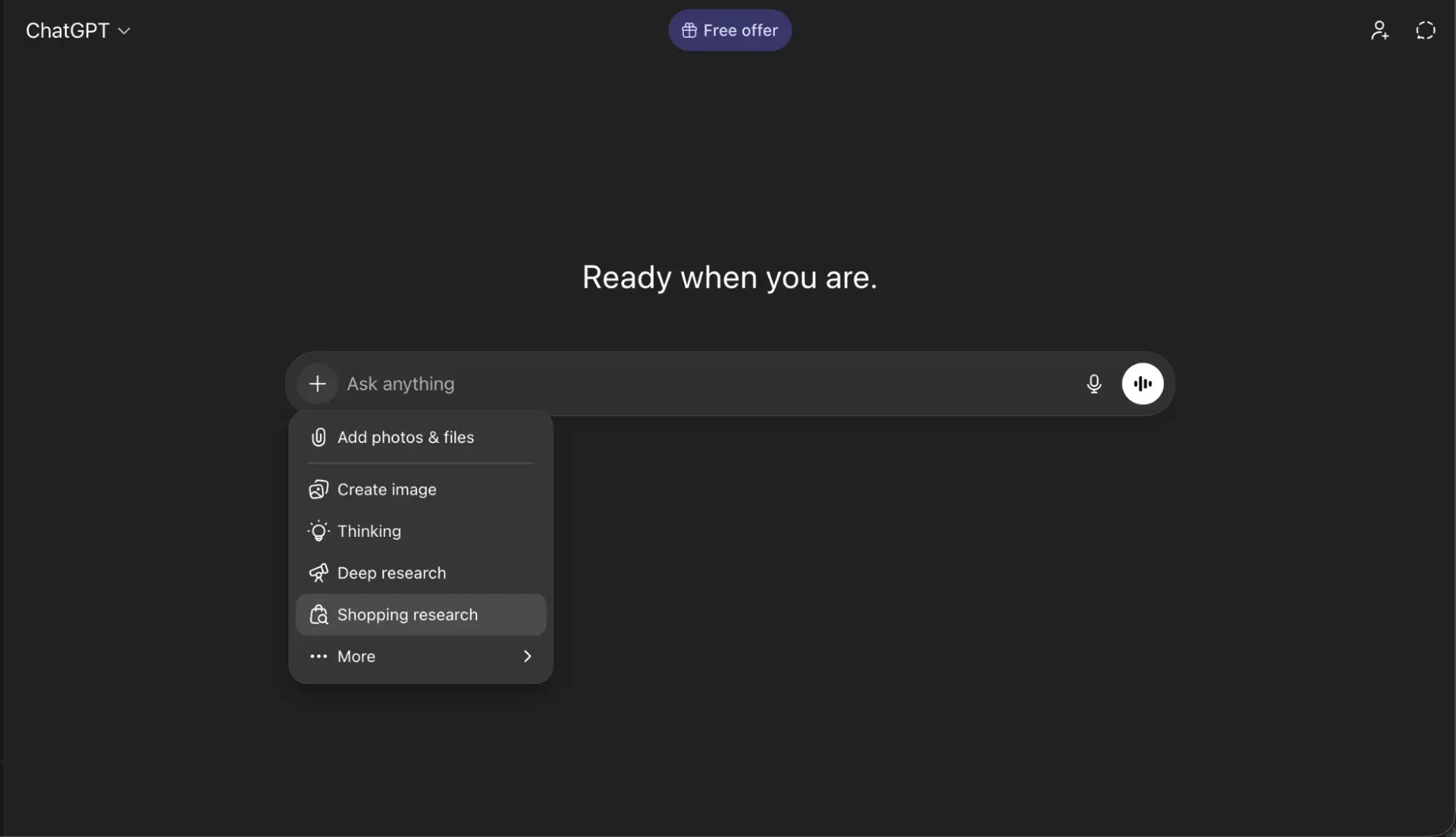
chatgpt product recommendations, accessing chatgpt shopping on desktop

From there, I entered what I was looking for (in this case, “the best gifts for authentic indian chai loves”) and hit enter. As it generated its product recommendations, ChatGPT asked me some questions about price and preferences to refine its suggestions.
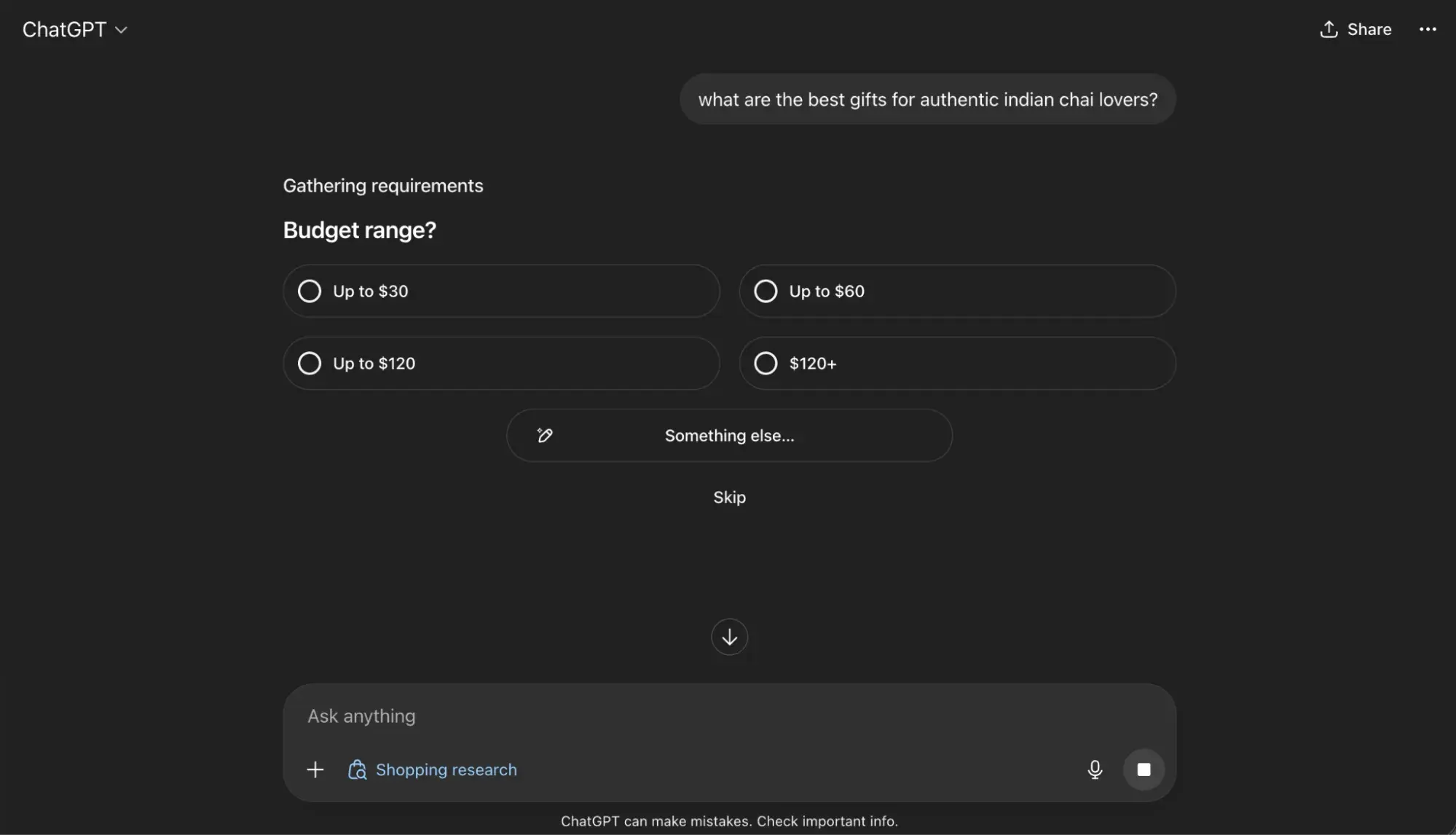
chatgpt product recommendations, chatgpt shopping on desktop asking product questions to refine recommendations

However, if you don’t answer the questions, it still gave you what it thought was best in a detailed listicle.
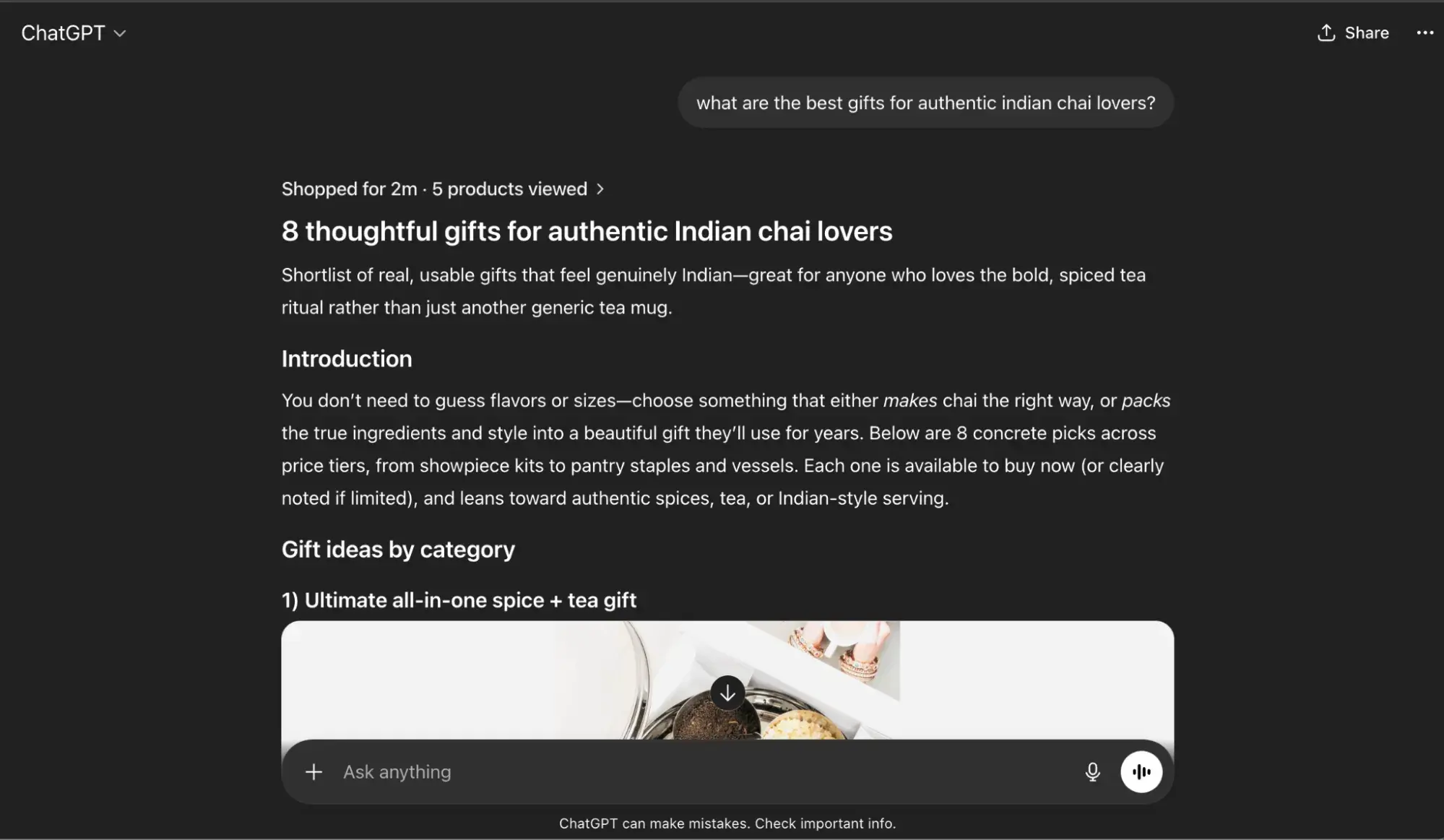
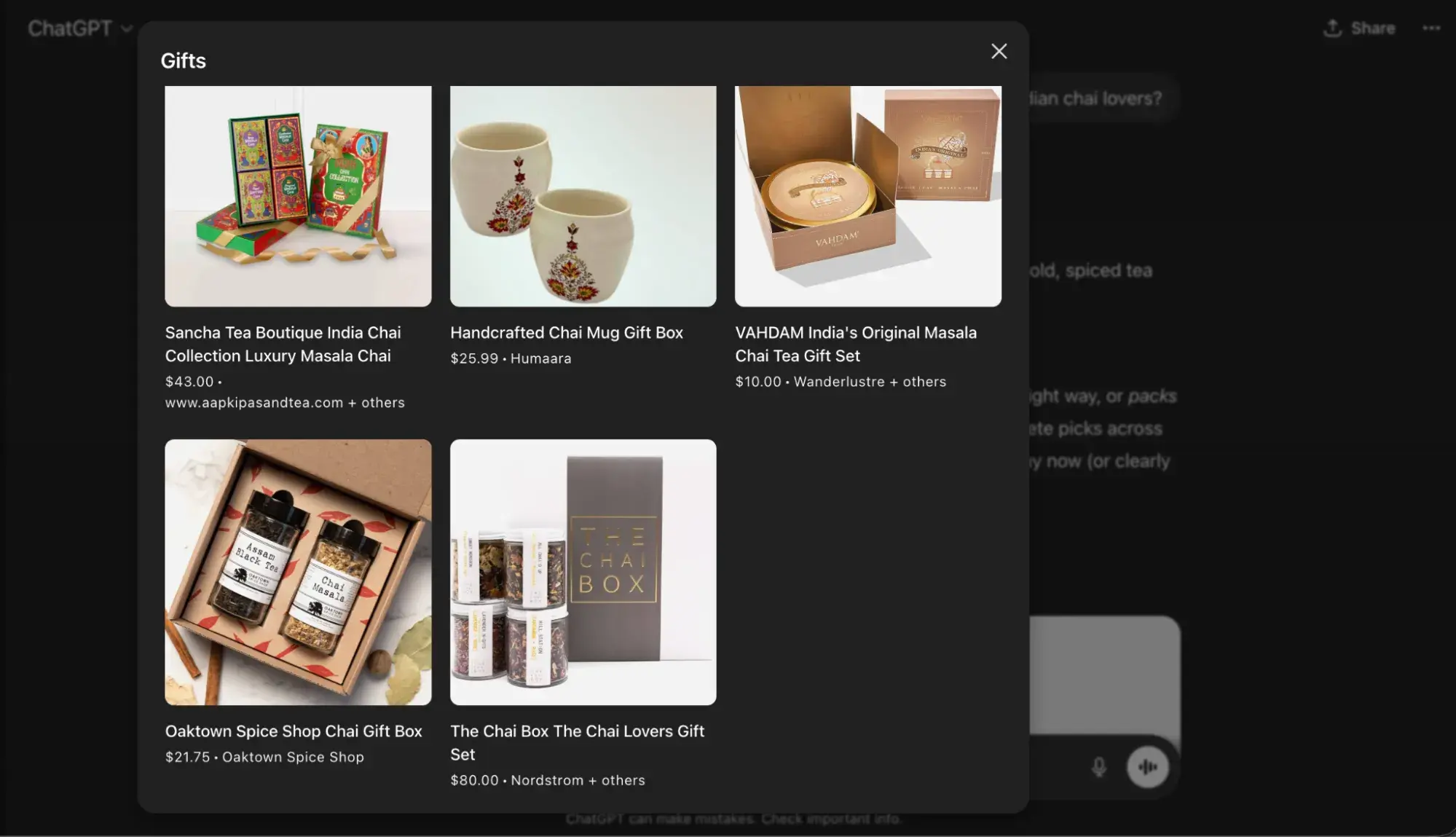
chatgpt product recommendations delivered in editorial form

chatgpt product recommendations also delivered in ecommerce format

As I scrolled through, I saw some suggestions opened side panels to purchase the product in-chat like this gift set from VADHAM.
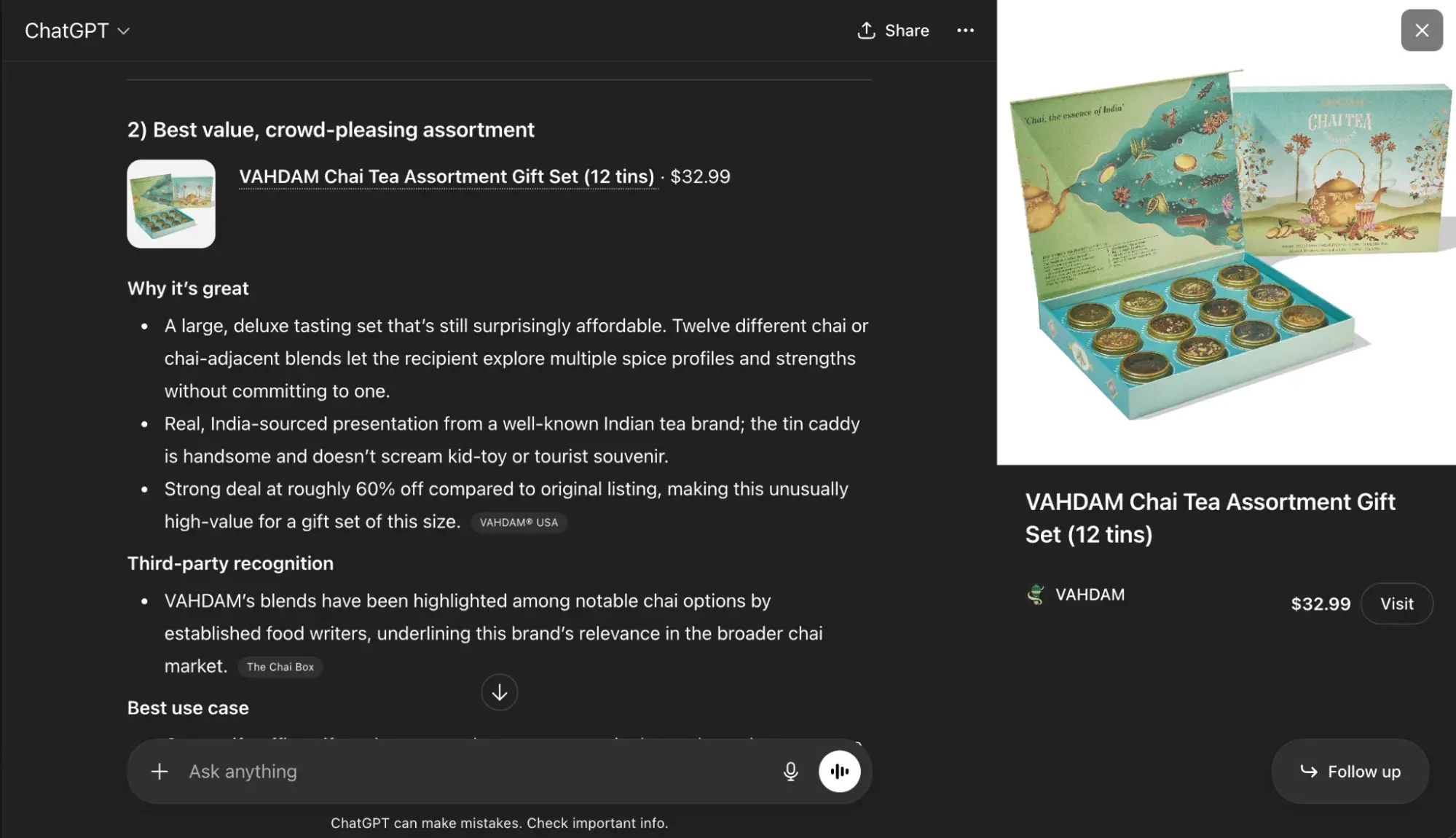
chatgpt product recommendations showing product details in a panel

And others had me to click through to the website.

You’re probably wondering, how is this any different from a normal ChatGPT query? Well, if you don’t use the “Shopping Research” tool, ChatGPT will share general gift ideas rather than specific products you can buy immediately.
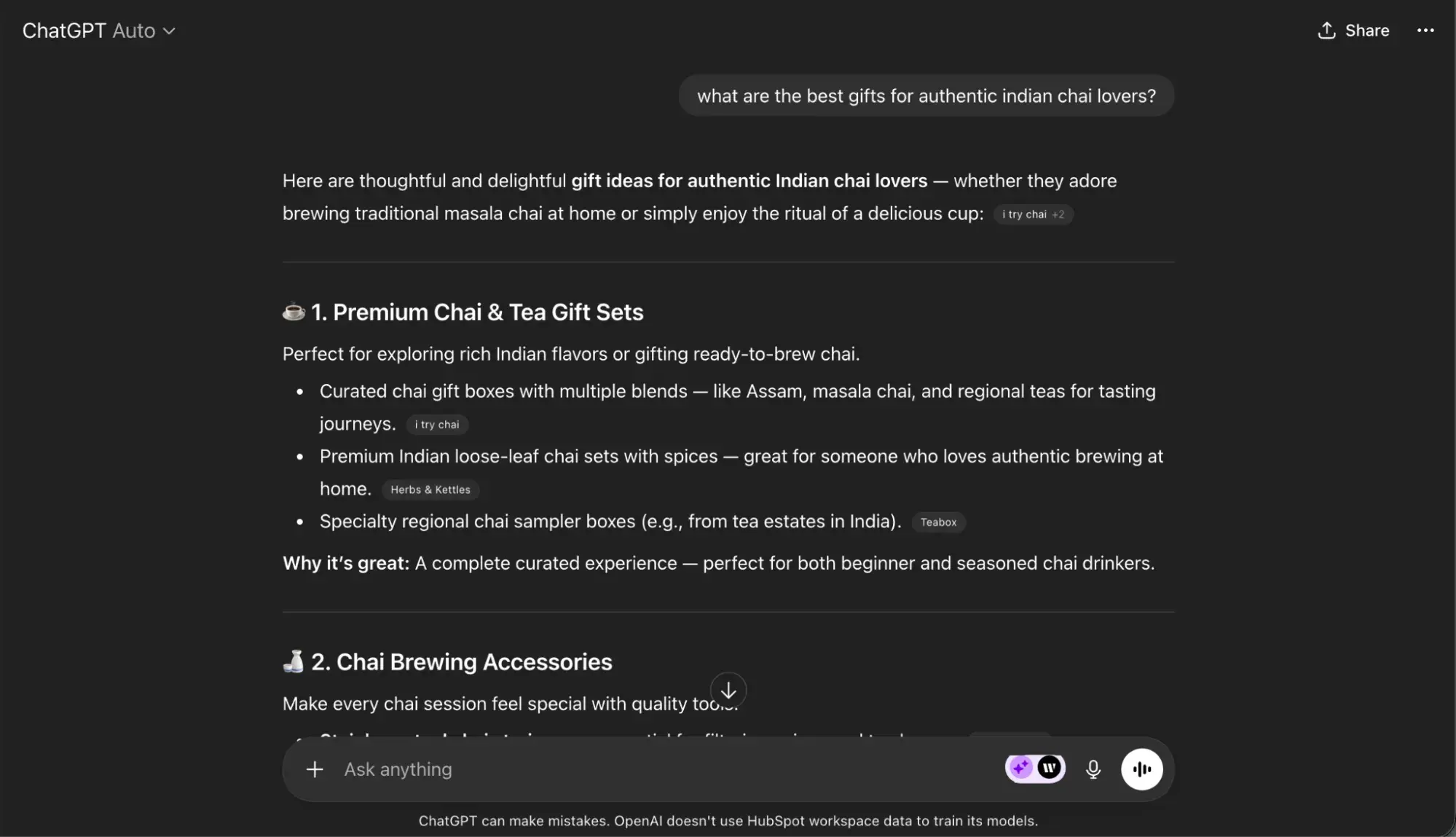
chatgpt product recommendations outside of “shopping research” tool are more general

Let’s look at what’s different in ChatGPT shopping in 2026, more granularly:

  • A specialized shopping model powers recommendations. ChatGPT Shopping Research runs on a specialized variant of GPT-5 mini, trained specifically for shopping tasks. According to OpenAI’s own benchmarks, this model achieves 52% product accuracy on complex multi-constraint queries, compared to 37% for standard ChatGPT Search.
  • The ChatGPT Merchant Program is live. OpenAI’s merchant program allows businesses to submit product feeds directly, improving the likelihood ChatGPT can access accurate, structured product information. Plans include an Instant Checkout, allowing users to buy directly within the platform.
  • B2B and SaaS are on board. Product discovery isn’t limited to ecommerce or B2C. ChatGPT regularly recommends software tools, platforms, and services when users ask for solutions to business problems.
  • No paid placement (yet). Unlike Google Shopping, ChatGPT product recommendations are currently not ad-driven. According to OpenAI, “ChatGPT shows the most relevant products from across the web. Product results are organic and unsponsored, ranked purely on relevance to the user.” Visibility here is earned, not bought — but more on that soon.

Why ChatGPT Product Discovery Matters for B2B and SaaS

Getting crawled by ChatGPT means potential visibility to the platform’s reported 900 million weekly active users. And ChatGPT product recommendations aren’t limited to just consumer goods.

If your company sells software, professional services, or any high-consideration product, ChatGPT discovery may already be affecting your pipeline, whether you’ve optimized for it or not. Let me explain.

B2B buyers are using AI to build shortlists.

Decision-makers at mid-market and enterprise companies are running AI queries like “What HubSpot competitors should I evaluate?” before they ever visit a vendor’s website. In other words, AI is narrowing down their choices from the very beginning of their buying journey.

On top of that, 6sense found that 95% of the time, the winning vendor is already on the buyer's short list, while 80% of the deals are won by the vendor the buyer contacts first. So, if you’re not being surfaced early by AI, you’re likely not even in the running.

AI search is already the second-biggest lead source for B2B.

According to a 2025 study by 10Fold Communications, AI-based platforms like ChatGPT and Perplexity are now the second-most common source of qualified leads. They're behind only social media and ahead of organic search, email marketing, and paid media.

AI traffic converts dramatically better.

Research shows ChatGPT traffic converted 31% higher than non-branded organic search. For B2B specifically, ChatGPT delivers a 56.3% higher close rate than leads originating from Google or Bing.

Users arriving from ChatGPT also often have already completed early-stage research. They’re closer to a decision, which typically means higher conversion rates and shorter sales cycles. These findings are consistent with theories about AI shifting buyer behavior and preferences, and marketers should be adapting.

Review platforms carry even more weight.

For B2B products, ChatGPT leans heavily on aggregator signals from platforms like G2, Capterra, and TrustRadius. Weak review presence is a visibility killer.

Pro Tip: Run a few ChatGPT queries in your category right now. Search “best [your product type] for [your ICP]” and note who shows up. This will give you a solid AI visibility benchmark to work from.

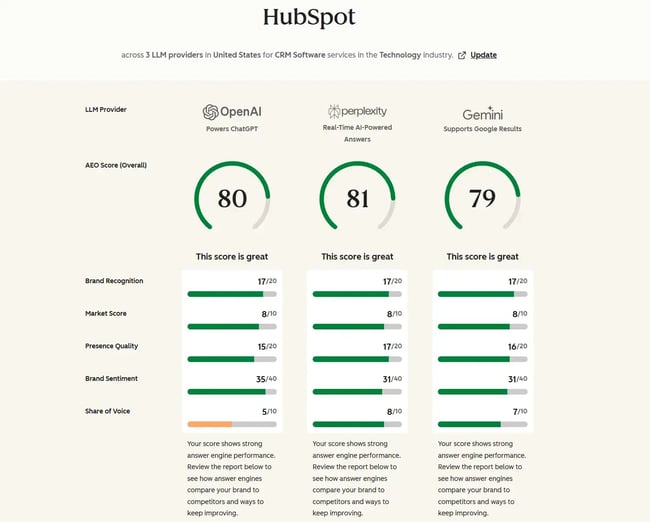
You can also use HubSpot’s free AEO Grader to see how your content is currently being interpreted by AI systems.
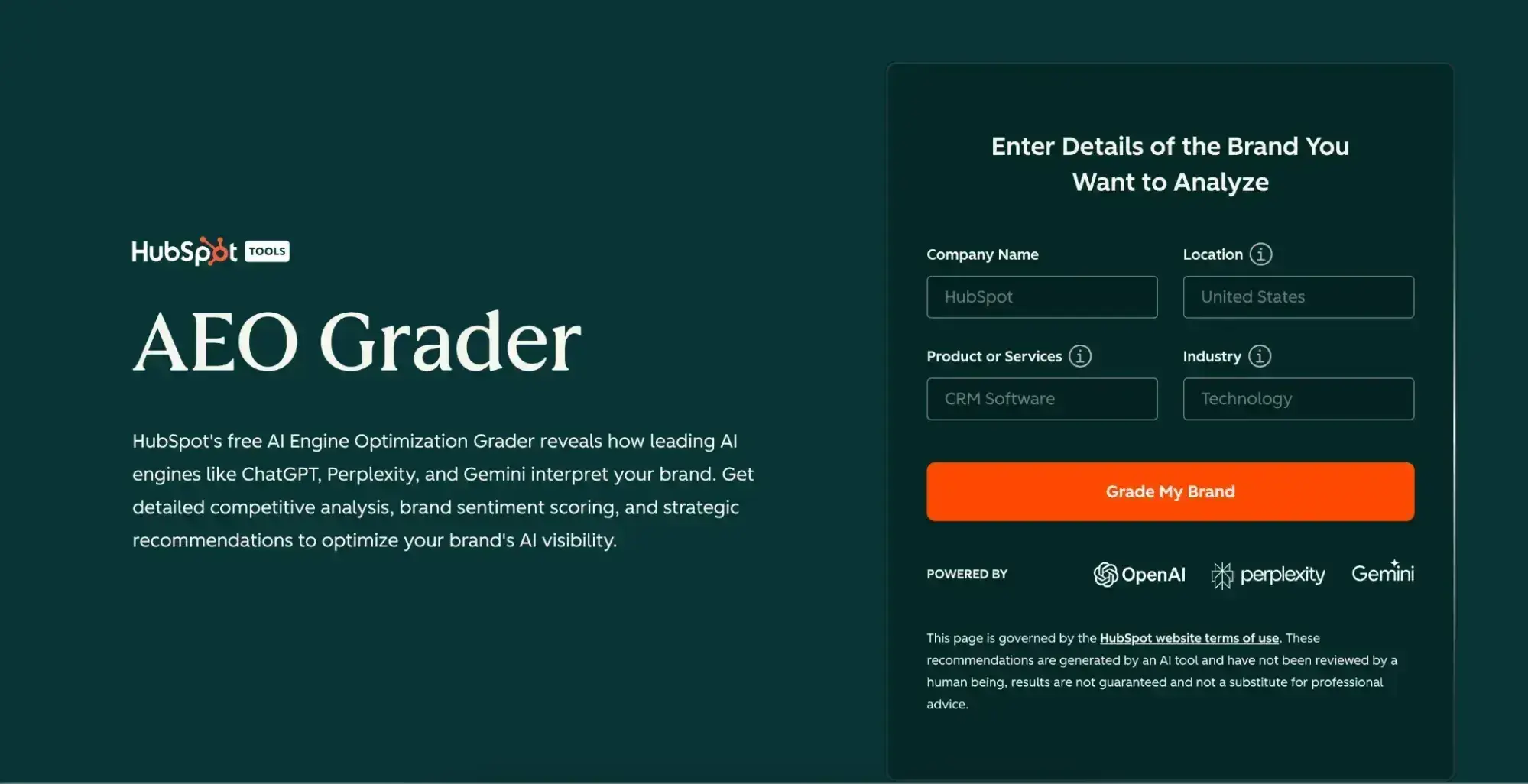
chatgpt product recommendations, assess how you perform in ai systems in general with hubspot aeo grader

How ChatGPT Product Recommendations Work

ChatGPT doesn’t have a top-secret algorithm in the Google sense. Rather, it claims to synthesize information from multiple sources and apply large language model (LLM) reasoning to answer shopping queries.

There are, however, some consistent signals that seem to influence what gets recommended.

ChatGPT product recommendations are influenced by query relevance, structured data on product pages, product availability and product price, reviews and authority, and contextual alignment with buyer intent.

1. Query Relevance

The most fundamental signal is how well your product’s content matches the intent of the user’s query. ChatGPT loves semantic matching. It doesn’t just look for keyword overlap; it interprets meaning and intent.

For example, if a user asks for “a lightweight CRM for solo consultants,” a product page that explicitly states that use case will outperform one that generically claims to serve all businesses.

Furthermore, Nectiv’s October 2025 analysis found that commercial intent prompts are significantly more likely to trigger web searches in ChatGPT (53.5%) than informational queries (18.7%). The most common terms that trigger a search include “reviews,” “free,” “features,” and “comparison.”

2. Structured Data on Product Pages

ChatGPT’s web browsing ability indexes product pages, and, as with all content, structured data (specifically schema markup) helps it parse product attributes more accurately. Schema types that are particularly relevant for product pages include: product schema, offer schema, and product variants.

3. Availability and Price Info

ChatGPT product recommendations are also believed to be influenced by product availability and price. Pricing pages are known to attract some of the most concentrated AI traffic. So, if your product is out of stock, discontinued, or has pricing that’s difficult to surface (like “contact for pricing” with no ranges), it’s at a disadvantage.

I mean, think about it: If a friend told you about a product, hyped it up, and then it turned out to be out of stock, you’d probably be really annoyed. (I would.) ChatGPT doesn’t want to give its users that experience.

4. Authority and Review Signals

Authority signals in AI work similarly to traditional SEO, but extend to third-party platforms, like established review sites, industry publications, analyst reports, and platforms like LinkedIn.

5. Context Alignment

ChatGPT tailors recommendations to the full context of a conversation and what it knows about a person. That said, a user who has mentioned they run a 10-person remote team and need a free solution will get different recommendations than someone who mentioned running an enterprise.

Your content needs to speak to specific use cases, personas, and contexts, not just the general product category, to show up as ChatGPT product recommendations to qualified audiences.

How to Help ChatGPT Discover Your Products

According to the Previsible 2025 State of AI Discovery Report, AI traffic concentrates most heavily on industry, tools, and pricing pages ‌a.k.a. ‌precisely the decision-stage pages that we know to drive B2B conversions. On top of that, HubSpot research has found ChatGPT is the #1 AI tool marketers use in their roles.

Despite the platform's popularity, however, only 11% of companies claim to have the majority of their content AI-ready. That presents a huge competitive opportunity.

Getting discovered by ChatGPT isn’t about gaming a system; it’s about having genuinely good, structured, accessible product information. Here are the most impactful steps you can take to increase your chances of showing up in ChatGPT’s product recommendations.

Step 1: Add product schema markup to your pages/content

Structured data is a pillar of both answer engine optimization (AEO) and generative answer optimization (GEO), so, of course, it’s important to ChatGPT.

Without schema markup and good site architecture, ChatGPT’s web crawler has to do more “thinking” to figure out your product details and what you’re all about. With it, that information is structured and clear, making it more explicit and machine-readable.

Read: How to Use Schema Markup to Improve Your Website's Structure

That said, for all your product pages, add the following:

  • Product schema: Include name, brand, image URL, description, SKU or GTIN, and a URL.
  • Offer schema: Include price, priceCurrency, availability (use schema.org values like InStock or OutOfStock), and a valid URL.
  • AggregateRating schema: Pull in review count and average rating from your review platform or record.
  • FAQPage schema: For landing pages that address common buyer questions, FAQ schema boosts context alignment.

And if you’re a B2B or SaaS company, treat your pricing page, feature comparison pages, and use-case landing pages as “product pages” for schema purposes. For SaaS, in particular, transparent pricing pages with clear tier breakdowns are a strong trust and visibility signal.

Pro Tip: Use Google’s Rich Results Test to verify your schema is installed correctly before expecting it to influence AI recommendations.

With HubSpot Content Hub, use HubSpot’s structured content tools and CMS developer documentation to implement JSON-LD schema directly in your page templates.

Step 2: Ensure crawlability and technical accessibility

As we mentioned, ChatGPT uses web crawlers (OAI-SearchBot is the primary one) to index content. If your product pages aren’t crawlable, you can’t be recommended, full stop.

In addition to schema, here are some things you can do to improve your crawlability:

  • Verify OAI-SearchBot is not blocked in your robots.txt file.
  • Submit an up-to-date XML sitemap that includes all product and solution pages.
  • Ensure product pages load quickly and don’t require JavaScript execution to render key content. Like search engines, faster-loading content is measurably more likely to be included by AI systems.
  • Use clear, descriptive URL structures (e.g., /products/crm-for-startups rather than /p?id=4421).
  • Eliminate duplicate content issues that dilute entity clarity.

Pro Tip: Check your server logs or a tool like Cloudflare Analytics for OAI-SearchBot activity. If it’s not showing up, investigate your robots.txt and page rendering. Your site may not be crawlable at the moment.

Step 3: Optimize product page content for use-case queries

Think like a buyer using natural language, not a marketer writing for robots.

ChatGPT users phrase queries conversationally, and product content that answers questions or includes those phrases explicitly is often favored.

Here’s what you can do:

  • Lead with the use case or “benefit,” not the feature. Instead of “AI-powered pipeline automation,” write “HubSpot helps sales teams of 10–50 people close more deals without manual data entry.”
  • Add comparison content. Pages like “HubSpot vs. Salesforce for small business” are exactly what ChatGPT draws from when users are weighing their options.
  • Include explicit use case headers. Sections like “Best for freelancers,” “Ideal for enterprise,” or “How [Product] handles [specific workflow]” create context for AI systems.
  • Answer the top 5–10 questions your buyers ask. Use FAQ sections on product pages. This content maps directly to ChatGPT conversational queries.

But don’t forget to differentiate! While you want to capture your audience’s words, you also want to make sure your unique offering and what makes you the right choice is clear and distinct from your competition.

It’s also important to note that ChatGPT’s instant checkout is currently limited to Etsy and Shopify shops. If you’re using either platform, make sure to follow these tips on your Shopify product descriptions/pages and Etsy Shop descriptions.

Need help writing your content? There are a host of AI content writing tools to get you started, including HubSpot’s.

Step 4: Build review and social proof Infrastructure

ChatGPT product recommendations are heavily influenced by what authoritative external sources say about your product, especially third-party review sites. This means your social proof strategy needs to extend beyond your own website.

For B2B and SaaS:

  • Prioritize G2 and Capterra. These are among the most crawled and referenced sources for software recommendations. Aim for at least 50 reviews with an average rating of 4.0+. Any fewer will look like too small a sample size to trust and any rating lower will reflect badly on your service.
  • Optimize your G2 profile. Treat your G2 listing like a landing page. Include a complete description, feature tags, use case categories, website links, and comparison positioning.
  • Pull social proof from LinkedIn. Customer testimonials, case study shares, and product mentions on LinkedIn are increasingly surfaced by ChatGPT, especially for B2B queries.
  • Earn coverage on relevant industry publications. Getting mentioned in respected trade publications (think MarTech, TechCrunch, industry newsletters) builds the authority signals ChatGPT weighs.
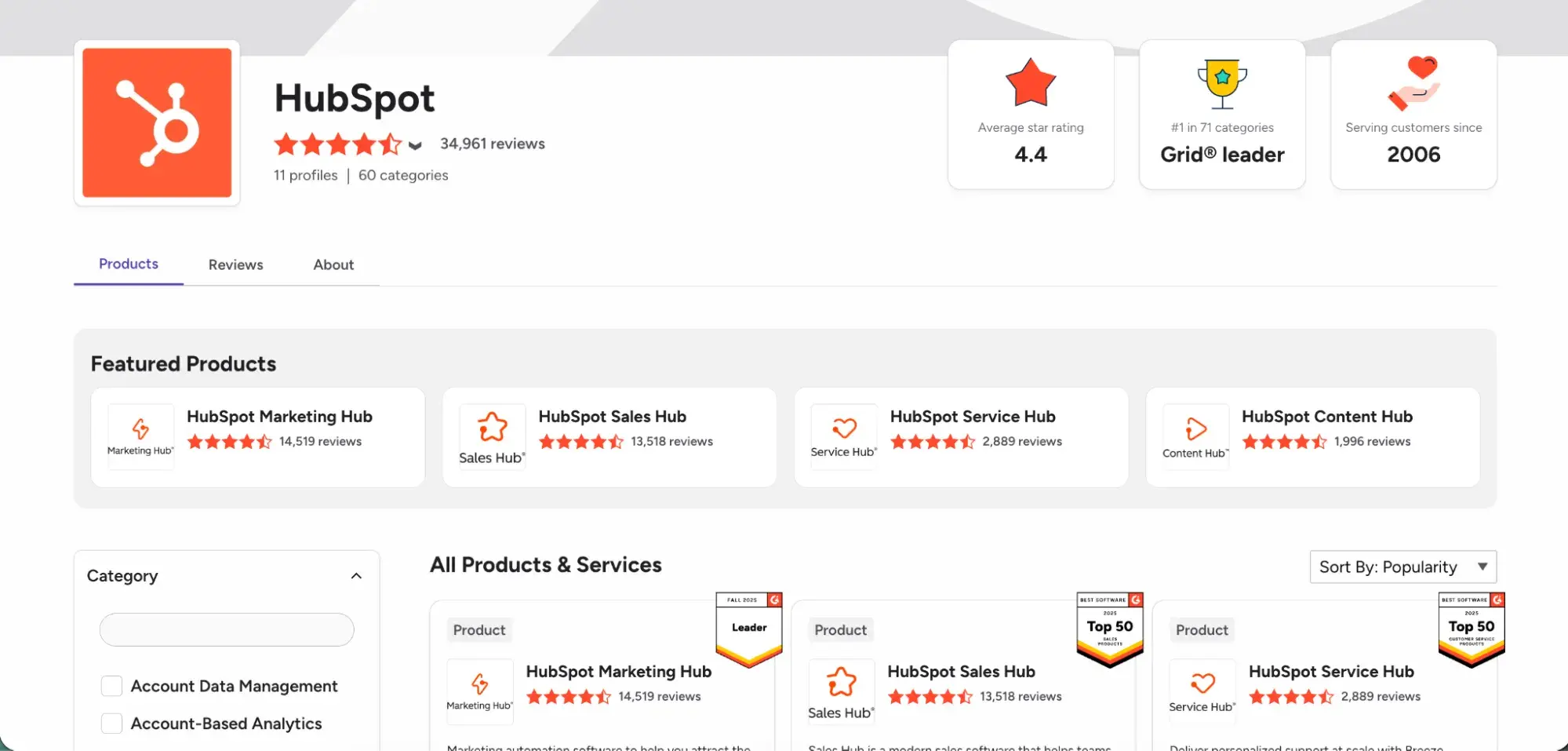
chatgpt product recommendations look at your brand’s rating and reputation on third-party sites, especially review sites like g2 or capterra.

Notice how HubSpot incorporated social proof and reviews from G2 onto our website. The more consistently your product is mentioned positively across these sources, the more likely it is to surface.
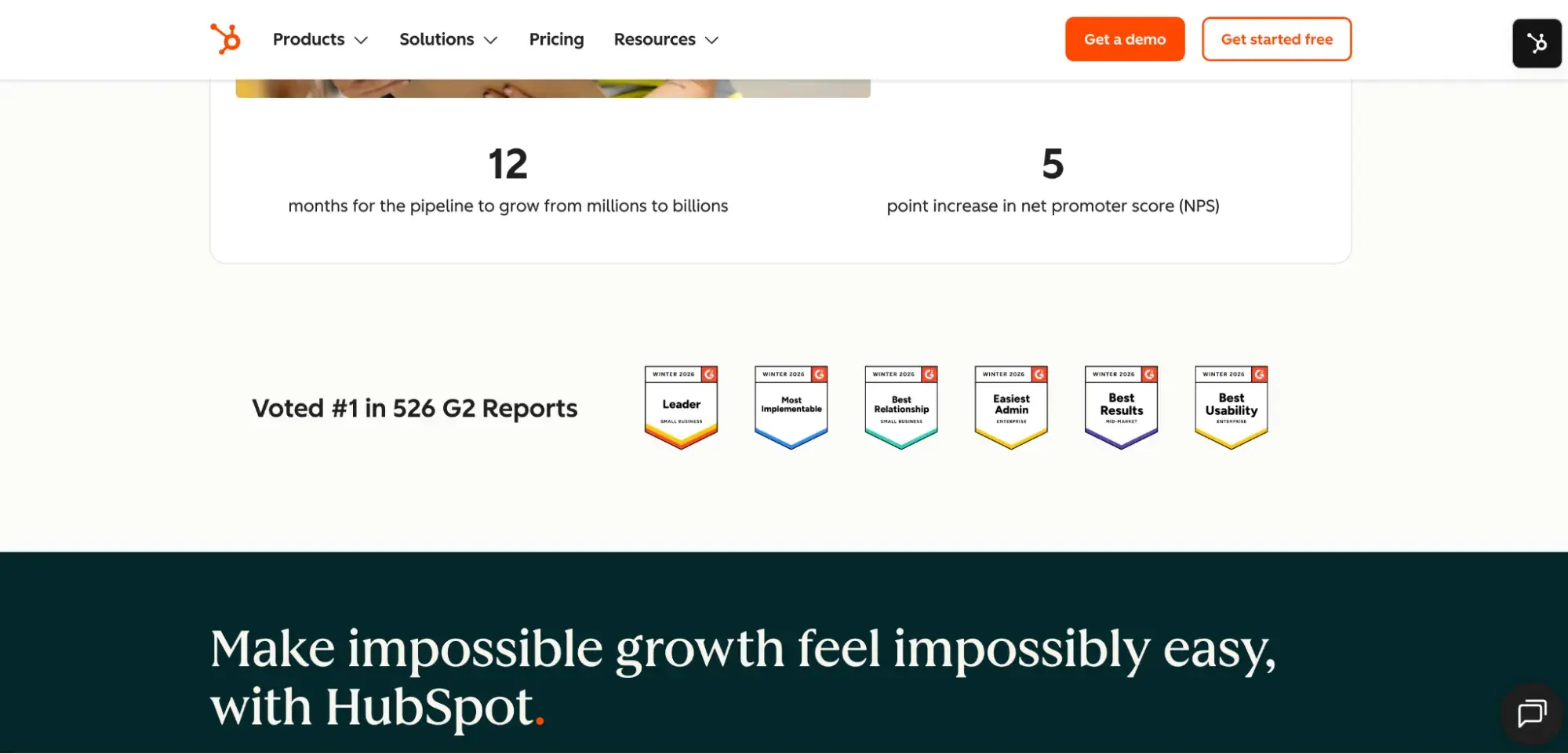
hubspot highlights social proof from third-party sites to help optimize for chatgpt product recommendations

Pro Tip: Use HubSpot’s Smart CRM to connect review request workflows directly to customer lifecycle data. This makes it easier to trigger review asks at the right moment post-onboarding.

Step 5: Submit a Product Feed to ChatGPT Merchant Program

OpenAI’s Merchant Program gives businesses a direct channel to make product information and purchasing available in ChatGPT. Think of it like having a feed from Facebook Marketplace or Instagram Shops in a conversation, but with AI recommendations.

To get started:

  • Visit chatgpt.com/merchants and create a merchant account.
  • Prepare a product feed in a supported format (typically JSON or CSV).
  • Include accurate product names, descriptions, prices, availability status, images, and URLs.
  • Keep the feed updated — stale or inaccurate data can actively harm your recommendation eligibility. However, OpenAI’s documentation explicitly acknowledges that the model may still make mistakes about current pricing and availability and encourages users to verify on merchant sites.

Pro Tip: For B2B companies without a traditional product feed, consider creating a structured “solutions feed” that lists your key offerings, including pricing tiers, target audiences, and use cases. This helps give ChatGPT clean, machine-readable data to work with.

After that, use HubSpot's AEO Grader to find problems with how AI systems are understanding your content.

Step 6: Build a Measurement Loop

You can’t manage what you don’t measure. Tracking ChatGPT-driven discovery requires a slightly different approach than traditional SEO analytics.

Build your monitoring workflow around these signals:

  • UTM-tag your ChatGPT traffic. If you’re linked or cited in ChatGPT responses, monitor direct/referral traffic patterns in Google Analytics 4 — AI-driven traffic often appears as direct or from chat.openai.com. Segment and track it separately from your first day.
  • Run regular probe queries. Weekly, manually run 10–20 queries in ChatGPT that match your target buyer’s language. Note when you appear, what competitors appear, and how the response positions you.
  • Track brand mentions with monitoring tools. Tools like Mention, Brand24, or HubSpot’s Social Monitoring in Marketing Hub can capture when your product is mentioned across the web — which feeds the authority signals ChatGPT draws from. You can also see AI traffic in HubSpot’s traffic report.
  • Monitor G2 and review platform rankings. Your position in category rankings on G2 correlates with AI recommendation frequency. Track it monthly.

FAQs About ChatGPT Product Recommendations

Do I need a product feed to appear in ChatGPT recommendations?

Not necessarily, but having one significantly improves your chances.

ChatGPT can discover products through web crawling alone, but a product feed submitted via the ChatGPT Merchant Program gives OpenAI direct, internal access to clean, structured data without the extra work.

For products with many variants, frequent price changes, or availability fluctuations (i.e. clothing and other consumer goods), a feed is strongly recommended.

How do I help ChatGPT discover new or seasonal products faster?

Update your sitemap immediately when new product pages go live and ensure they’re linked from existing high-authority pages.

For seasonal products, create evergreen landing pages (e.g., “[Product] for Holiday Gifting”) that you update each cycle rather than creating new URLs annually. This preserves crawl priority and authority signals.

Submitting updated product feeds promptly also accelerates discovery.

What if my competitors outrank me even with correct schema?

To be blunt, this is very likely. Schema is necessary but not a panacea.

If competitors are outperforming you despite correct markup, the gap is usually in one of three areas: (1) review volume and quality on third-party platforms, (2) content authority and depth on use-case-specific pages, or (3) brand mention frequency across external publications.

Audit your G2 profile versus competitors, compare your product page content depth, and assess how often you’re cited in industry sources versus your top competitors. 10Fold 2025 research found that content depth and readability matter most for AI citation, not traditional SEO metrics like backlinks or traffic.

How should I monitor product page performance from AI traffic?

In Google Analytics 4, segment traffic by source to identify sessions originating from chat.openai.com or appearing as “direct” with AI-typical behavior patterns (low pages-per-session, high conversion rates).

Use HubSpot Marketing Hub to track keyword-level and page-level performance alongside your CRM pipeline data, enabling you to connect AI-driven traffic to actual revenue outcomes. For a comprehensive framework, HubSpot’s AEO Guide walks through the full answer engine optimization workflow.

Structure for ChatGPT Shopping Success

The data is clear: AI referral traffic is growing 165x faster than organic search, converts at 4–9x the rate of traditional visitors, and is already the most influential force shaping B2B vendor shortlists. So, if you think you can ignore ChatGPT product recommendations, you’ll want to think again.

ChatGPT product recommendations aren’t a paid channel; they’re an earned one. The businesses that will dominate AI-driven discovery in 2026 are the ones that give AI systems clean, structured, authoritative data to work with.

Start with your product schema. Fix your crawlability. Build your review site presence. And monitor it all consistently. All of this compounds and can help turn ChatGPT into your audience’s most reliable personal shopper.


from Marketing https://blog.hubspot.com/marketing/chatgpt-product-recommendations

Whether I’m looking for a new car, email marketing software, or pair of shoes, sometimes I wish I had a personal shopper — Someone to share a second opinion, make suggestions when I’m indecisive, and help find the best deal. In recent years, ChatGPT product recommendations and its Shopping Research feature have become this for many.Download Now: HubSpot's Free AEO Guide

Increasingly, shoppers are skipping search engines and going straight to ChatGPT with queries like “best CRM for startups under 50 people” or “what are the best gifts for chai lovers?” In fact, according to G2’s 2025 Buyer Behavior Report, generative AI chatbots are now the #1 influence over vendor shortlists, ahead of review sites, vendor websites, and salespeople.

That’s a huge shift in how people shop, and marketers and ecommerce teams need to adapt if they want to stay visible. This guide breaks down exactly how ChatGPT decides which products to surface — and, more importantly, what you can do today to be one of them.

Table of Contents

What’s Changed in ChatGPT Shopping for Businesses?

In a 2025 survey of 1,000+ B2B software buyers by G2, half of the respondents said they now start their buying journey in an AI chatbot instead of Google Search. ChatGPT took notice.

Last fall, ChatGPT launched ChatGPT Shopping and instant checkout. These new features let users find and even buy products (on Etsy and Shopify) without leaving their chat.

ChatGPT will suggest products, prices, reviews, and a link to buy the item right away for Etsy and Shopify brands. You can also buy the item from their websites to add it to your cart.

Here’s a quick example. To launch the shopping experience on mobile or desktop, I clicked the plus sign (+) near the query field and select “Shopping Research.”

chatgpt product recommendations, accessing chatgpt shopping on desktop

From there, I entered what I was looking for (in this case, “the best gifts for authentic indian chai loves”) and hit enter. As it generated its product recommendations, ChatGPT asked me some questions about price and preferences to refine its suggestions.

chatgpt product recommendations, chatgpt shopping on desktop asking product questions to refine recommendations

However, if you don’t answer the questions, it still gave you what it thought was best in a detailed listicle.

chatgpt product recommendations delivered in editorial form

chatgpt product recommendations also delivered in ecommerce format

As I scrolled through, I saw some suggestions opened side panels to purchase the product in-chat like this gift set from VADHAM.

chatgpt product recommendations showing product details in a panel

And others had me to click through to the website.

You’re probably wondering, how is this any different from a normal ChatGPT query? Well, if you don’t use the “Shopping Research” tool, ChatGPT will share general gift ideas rather than specific products you can buy immediately.

chatgpt product recommendations outside of “shopping research” tool are more general

Let’s look at what’s different in ChatGPT shopping in 2026, more granularly:

  • A specialized shopping model powers recommendations. ChatGPT Shopping Research runs on a specialized variant of GPT-5 mini, trained specifically for shopping tasks. According to OpenAI’s own benchmarks, this model achieves 52% product accuracy on complex multi-constraint queries, compared to 37% for standard ChatGPT Search.
  • The ChatGPT Merchant Program is live. OpenAI’s merchant program allows businesses to submit product feeds directly, improving the likelihood ChatGPT can access accurate, structured product information. Plans include an Instant Checkout, allowing users to buy directly within the platform.
  • B2B and SaaS are on board. Product discovery isn’t limited to ecommerce or B2C. ChatGPT regularly recommends software tools, platforms, and services when users ask for solutions to business problems.
  • No paid placement (yet). Unlike Google Shopping, ChatGPT product recommendations are currently not ad-driven. According to OpenAI, “ChatGPT shows the most relevant products from across the web. Product results are organic and unsponsored, ranked purely on relevance to the user.” Visibility here is earned, not bought — but more on that soon.

Why ChatGPT Product Discovery Matters for B2B and SaaS

Getting crawled by ChatGPT means potential visibility to the platform’s reported 900 million weekly active users. And ChatGPT product recommendations aren’t limited to just consumer goods.

If your company sells software, professional services, or any high-consideration product, ChatGPT discovery may already be affecting your pipeline, whether you’ve optimized for it or not. Let me explain.

B2B buyers are using AI to build shortlists.

Decision-makers at mid-market and enterprise companies are running AI queries like “What HubSpot competitors should I evaluate?” before they ever visit a vendor’s website. In other words, AI is narrowing down their choices from the very beginning of their buying journey.

On top of that, 6sense found that 95% of the time, the winning vendor is already on the buyer's short list, while 80% of the deals are won by the vendor the buyer contacts first. So, if you’re not being surfaced early by AI, you’re likely not even in the running.

AI search is already the second-biggest lead source for B2B.

According to a 2025 study by 10Fold Communications, AI-based platforms like ChatGPT and Perplexity are now the second-most common source of qualified leads. They're behind only social media and ahead of organic search, email marketing, and paid media.

AI traffic converts dramatically better.

Research shows ChatGPT traffic converted 31% higher than non-branded organic search. For B2B specifically, ChatGPT delivers a 56.3% higher close rate than leads originating from Google or Bing.

Users arriving from ChatGPT also often have already completed early-stage research. They’re closer to a decision, which typically means higher conversion rates and shorter sales cycles. These findings are consistent with theories about AI shifting buyer behavior and preferences, and marketers should be adapting.

Review platforms carry even more weight.

For B2B products, ChatGPT leans heavily on aggregator signals from platforms like G2, Capterra, and TrustRadius. Weak review presence is a visibility killer.

Pro Tip: Run a few ChatGPT queries in your category right now. Search “best [your product type] for [your ICP]” and note who shows up. This will give you a solid AI visibility benchmark to work from.

You can also use HubSpot’s free AEO Grader to see how your content is currently being interpreted by AI systems.

chatgpt product recommendations, assess how you perform in ai systems in general with hubspot aeo grader

How ChatGPT Product Recommendations Work

ChatGPT doesn’t have a top-secret algorithm in the Google sense. Rather, it claims to synthesize information from multiple sources and apply large language model (LLM) reasoning to answer shopping queries.

There are, however, some consistent signals that seem to influence what gets recommended.

ChatGPT product recommendations are influenced by query relevance, structured data on product pages, product availability and product price, reviews and authority, and contextual alignment with buyer intent.

1. Query Relevance

The most fundamental signal is how well your product’s content matches the intent of the user’s query. ChatGPT loves semantic matching. It doesn’t just look for keyword overlap; it interprets meaning and intent.

For example, if a user asks for “a lightweight CRM for solo consultants,” a product page that explicitly states that use case will outperform one that generically claims to serve all businesses.

Furthermore, Nectiv’s October 2025 analysis found that commercial intent prompts are significantly more likely to trigger web searches in ChatGPT (53.5%) than informational queries (18.7%). The most common terms that trigger a search include “reviews,” “free,” “features,” and “comparison.”

2. Structured Data on Product Pages

ChatGPT’s web browsing ability indexes product pages, and, as with all content, structured data (specifically schema markup) helps it parse product attributes more accurately. Schema types that are particularly relevant for product pages include: product schema, offer schema, and product variants.

3. Availability and Price Info

ChatGPT product recommendations are also believed to be influenced by product availability and price. Pricing pages are known to attract some of the most concentrated AI traffic. So, if your product is out of stock, discontinued, or has pricing that’s difficult to surface (like “contact for pricing” with no ranges), it’s at a disadvantage.

I mean, think about it: If a friend told you about a product, hyped it up, and then it turned out to be out of stock, you’d probably be really annoyed. (I would.) ChatGPT doesn’t want to give its users that experience.

4. Authority and Review Signals

Authority signals in AI work similarly to traditional SEO, but extend to third-party platforms, like established review sites, industry publications, analyst reports, and platforms like LinkedIn.

5. Context Alignment

ChatGPT tailors recommendations to the full context of a conversation and what it knows about a person. That said, a user who has mentioned they run a 10-person remote team and need a free solution will get different recommendations than someone who mentioned running an enterprise.

Your content needs to speak to specific use cases, personas, and contexts, not just the general product category, to show up as ChatGPT product recommendations to qualified audiences.

How to Help ChatGPT Discover Your Products

According to the Previsible 2025 State of AI Discovery Report, AI traffic concentrates most heavily on industry, tools, and pricing pages ‌a.k.a. ‌precisely the decision-stage pages that we know to drive B2B conversions. On top of that, HubSpot research has found ChatGPT is the #1 AI tool marketers use in their roles.

Despite the platform's popularity, however, only 11% of companies claim to have the majority of their content AI-ready. That presents a huge competitive opportunity.

Getting discovered by ChatGPT isn’t about gaming a system; it’s about having genuinely good, structured, accessible product information. Here are the most impactful steps you can take to increase your chances of showing up in ChatGPT’s product recommendations.

Step 1: Add product schema markup to your pages/content

Structured data is a pillar of both answer engine optimization (AEO) and generative answer optimization (GEO), so, of course, it’s important to ChatGPT.

Without schema markup and good site architecture, ChatGPT’s web crawler has to do more “thinking” to figure out your product details and what you’re all about. With it, that information is structured and clear, making it more explicit and machine-readable.

Read: How to Use Schema Markup to Improve Your Website's Structure

That said, for all your product pages, add the following:

  • Product schema: Include name, brand, image URL, description, SKU or GTIN, and a URL.
  • Offer schema: Include price, priceCurrency, availability (use schema.org values like InStock or OutOfStock), and a valid URL.
  • AggregateRating schema: Pull in review count and average rating from your review platform or record.
  • FAQPage schema: For landing pages that address common buyer questions, FAQ schema boosts context alignment.

And if you’re a B2B or SaaS company, treat your pricing page, feature comparison pages, and use-case landing pages as “product pages” for schema purposes. For SaaS, in particular, transparent pricing pages with clear tier breakdowns are a strong trust and visibility signal.

Pro Tip: Use Google’s Rich Results Test to verify your schema is installed correctly before expecting it to influence AI recommendations.

With HubSpot Content Hub, use HubSpot’s structured content tools and CMS developer documentation to implement JSON-LD schema directly in your page templates.

Step 2: Ensure crawlability and technical accessibility

As we mentioned, ChatGPT uses web crawlers (OAI-SearchBot is the primary one) to index content. If your product pages aren’t crawlable, you can’t be recommended, full stop.

In addition to schema, here are some things you can do to improve your crawlability:

  • Verify OAI-SearchBot is not blocked in your robots.txt file.
  • Submit an up-to-date XML sitemap that includes all product and solution pages.
  • Ensure product pages load quickly and don’t require JavaScript execution to render key content. Like search engines, faster-loading content is measurably more likely to be included by AI systems.
  • Use clear, descriptive URL structures (e.g., /products/crm-for-startups rather than /p?id=4421).
  • Eliminate duplicate content issues that dilute entity clarity.

Pro Tip: Check your server logs or a tool like Cloudflare Analytics for OAI-SearchBot activity. If it’s not showing up, investigate your robots.txt and page rendering. Your site may not be crawlable at the moment.

Step 3: Optimize product page content for use-case queries

Think like a buyer using natural language, not a marketer writing for robots.

ChatGPT users phrase queries conversationally, and product content that answers questions or includes those phrases explicitly is often favored.

Here’s what you can do:

  • Lead with the use case or “benefit,” not the feature. Instead of “AI-powered pipeline automation,” write “HubSpot helps sales teams of 10–50 people close more deals without manual data entry.”
  • Add comparison content. Pages like “HubSpot vs. Salesforce for small business” are exactly what ChatGPT draws from when users are weighing their options.
  • Include explicit use case headers. Sections like “Best for freelancers,” “Ideal for enterprise,” or “How [Product] handles [specific workflow]” create context for AI systems.
  • Answer the top 5–10 questions your buyers ask. Use FAQ sections on product pages. This content maps directly to ChatGPT conversational queries.

But don’t forget to differentiate! While you want to capture your audience’s words, you also want to make sure your unique offering and what makes you the right choice is clear and distinct from your competition.

It’s also important to note that ChatGPT’s instant checkout is currently limited to Etsy and Shopify shops. If you’re using either platform, make sure to follow these tips on your Shopify product descriptions/pages and Etsy Shop descriptions.

Need help writing your content? There are a host of AI content writing tools to get you started, including HubSpot’s.

Step 4: Build review and social proof Infrastructure

ChatGPT product recommendations are heavily influenced by what authoritative external sources say about your product, especially third-party review sites. This means your social proof strategy needs to extend beyond your own website.

For B2B and SaaS:

  • Prioritize G2 and Capterra. These are among the most crawled and referenced sources for software recommendations. Aim for at least 50 reviews with an average rating of 4.0+. Any fewer will look like too small a sample size to trust and any rating lower will reflect badly on your service.
  • Optimize your G2 profile. Treat your G2 listing like a landing page. Include a complete description, feature tags, use case categories, website links, and comparison positioning.
  • Pull social proof from LinkedIn. Customer testimonials, case study shares, and product mentions on LinkedIn are increasingly surfaced by ChatGPT, especially for B2B queries.
  • Earn coverage on relevant industry publications. Getting mentioned in respected trade publications (think MarTech, TechCrunch, industry newsletters) builds the authority signals ChatGPT weighs.

chatgpt product recommendations look at your brand’s rating and reputation on third-party sites, especially review sites like g2 or capterra.

Notice how HubSpot incorporated social proof and reviews from G2 onto our website. The more consistently your product is mentioned positively across these sources, the more likely it is to surface.

hubspot highlights social proof from third-party sites to help optimize for chatgpt product recommendations

Pro Tip: Use HubSpot’s Smart CRM to connect review request workflows directly to customer lifecycle data. This makes it easier to trigger review asks at the right moment post-onboarding.

Step 5: Submit a Product Feed to ChatGPT Merchant Program

OpenAI’s Merchant Program gives businesses a direct channel to make product information and purchasing available in ChatGPT. Think of it like having a feed from Facebook Marketplace or Instagram Shops in a conversation, but with AI recommendations.

To get started:

  • Visit chatgpt.com/merchants and create a merchant account.
  • Prepare a product feed in a supported format (typically JSON or CSV).
  • Include accurate product names, descriptions, prices, availability status, images, and URLs.
  • Keep the feed updated — stale or inaccurate data can actively harm your recommendation eligibility. However, OpenAI’s documentation explicitly acknowledges that the model may still make mistakes about current pricing and availability and encourages users to verify on merchant sites.

Pro Tip: For B2B companies without a traditional product feed, consider creating a structured “solutions feed” that lists your key offerings, including pricing tiers, target audiences, and use cases. This helps give ChatGPT clean, machine-readable data to work with.

After that, use HubSpot's AEO Grader to find problems with how AI systems are understanding your content.

Step 6: Build a Measurement Loop

You can’t manage what you don’t measure. Tracking ChatGPT-driven discovery requires a slightly different approach than traditional SEO analytics.

Build your monitoring workflow around these signals:

  • UTM-tag your ChatGPT traffic. If you’re linked or cited in ChatGPT responses, monitor direct/referral traffic patterns in Google Analytics 4 — AI-driven traffic often appears as direct or from chat.openai.com. Segment and track it separately from your first day.
  • Run regular probe queries. Weekly, manually run 10–20 queries in ChatGPT that match your target buyer’s language. Note when you appear, what competitors appear, and how the response positions you.
  • Track brand mentions with monitoring tools. Tools like Mention, Brand24, or HubSpot’s Social Monitoring in Marketing Hub can capture when your product is mentioned across the web — which feeds the authority signals ChatGPT draws from. You can also see AI traffic in HubSpot’s traffic report.
  • Monitor G2 and review platform rankings. Your position in category rankings on G2 correlates with AI recommendation frequency. Track it monthly.

FAQs About ChatGPT Product Recommendations

Do I need a product feed to appear in ChatGPT recommendations?

Not necessarily, but having one significantly improves your chances.

ChatGPT can discover products through web crawling alone, but a product feed submitted via the ChatGPT Merchant Program gives OpenAI direct, internal access to clean, structured data without the extra work.

For products with many variants, frequent price changes, or availability fluctuations (i.e. clothing and other consumer goods), a feed is strongly recommended.

How do I help ChatGPT discover new or seasonal products faster?

Update your sitemap immediately when new product pages go live and ensure they’re linked from existing high-authority pages.

For seasonal products, create evergreen landing pages (e.g., “[Product] for Holiday Gifting”) that you update each cycle rather than creating new URLs annually. This preserves crawl priority and authority signals.

Submitting updated product feeds promptly also accelerates discovery.

What if my competitors outrank me even with correct schema?

To be blunt, this is very likely. Schema is necessary but not a panacea.

If competitors are outperforming you despite correct markup, the gap is usually in one of three areas: (1) review volume and quality on third-party platforms, (2) content authority and depth on use-case-specific pages, or (3) brand mention frequency across external publications.

Audit your G2 profile versus competitors, compare your product page content depth, and assess how often you’re cited in industry sources versus your top competitors. 10Fold 2025 research found that content depth and readability matter most for AI citation, not traditional SEO metrics like backlinks or traffic.

How should I monitor product page performance from AI traffic?

In Google Analytics 4, segment traffic by source to identify sessions originating from chat.openai.com or appearing as “direct” with AI-typical behavior patterns (low pages-per-session, high conversion rates).

Use HubSpot Marketing Hub to track keyword-level and page-level performance alongside your CRM pipeline data, enabling you to connect AI-driven traffic to actual revenue outcomes. For a comprehensive framework, HubSpot’s AEO Guide walks through the full answer engine optimization workflow.

Structure for ChatGPT Shopping Success

The data is clear: AI referral traffic is growing 165x faster than organic search, converts at 4–9x the rate of traditional visitors, and is already the most influential force shaping B2B vendor shortlists. So, if you think you can ignore ChatGPT product recommendations, you’ll want to think again.

ChatGPT product recommendations aren’t a paid channel; they’re an earned one. The businesses that will dominate AI-driven discovery in 2026 are the ones that give AI systems clean, structured, authoritative data to work with.

Start with your product schema. Fix your crawlability. Build your review site presence. And monitor it all consistently. All of this compounds and can help turn ChatGPT into your audience’s most reliable personal shopper.

via Perfecte news Non connection

miércoles, 11 de marzo de 2026

The simple genius behind this long-forgotten Google Chrome ad

We trust simple promises more than long lists. When brands focus on one clear benefit, it feels more believable than trying to do everything at once. Take it from Google.

Free AEO Grader: See How You Rank on AI Search Results

When Chrome launched in 2009, they called it, "The Fast Browser." They used this same line time and time again in multiple different ads. It’s a good line. But think for a second about all of the attributes Google didn’t mention.

They didn‘t mention how passwords are synced, how security is best-in-class, or integrations with Gmail. They didn’t mention the extensions, stability, or automatic updates. They could have done, but instead they focused on one benefit. Speed.

The campaign worked. Now, Chrome is the most popular browser in the world, capturing 71% of the market. Saying less can make your product feel more effective. Adding benefits can actually weaken persuasion. Here’s why.

Table of Contents

The Goal Dilution Effect

Google Chrome’s simple ad campaign is an example of the goal dilution effect. This cognitive bias causes people to believe products are less effective if they achieve multiple aims, instead of one focused goal. In short, the more benefits you give, the less believable those benefits are.

In a 2007 study by Zhang and Fishbach, participants were given information about how eating tomatoes could achieve certain goals.

  • Some are told eating tomatoes achieved just one goal: "help prevent cancer."

  • Others are told eating tomatoes achieves two goals: "help prevent cancer and degenerative disease of the eye." 

Zhang and Fishbach found that participants rated tomatoes as 12% more effective at preventing cancer when this was the only listed benefit, compared to when an additional health benefit was also included.

goal dillution, chrome

The Beauty of Simplicity: Five Guys

Five Guys benefited from the same bias in 1986 when Jerry Murrell launched the first store. They didn't attempt to be a jack-of-all-trades. They focused on one benefit, and that focus boosted how believable their claims seemed.

On Nudge Podcast, Richard Shotton explained how the Five Guys founder was inspired by the long queues outside of Thrasher’s Fries in Ocean City, Maryland. He’s quoted as saying, “There must’ve been 20 places selling boardwalk fries, but only one place had a long line.”

goal dillution, five guys

Why did Thrasher’s have such popularity? Well, according to Murrell, it was their focus. Thrashers only offered fries, nothing else.

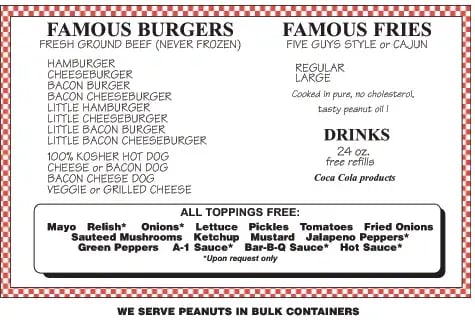
Five Guys replicated the same tactic. Rather than offering side salads, desserts, fish fillets and other items synonymous with fast food stores. Five Guys only offered the bare minimum: burger and fries.

goal dillution, five guys menu

That simple menu helped Five Guys explode in popularity. The chain exploded in the mid-2010s, growing by over 700% in six years. With limited menus, the brand could focus on making excellent burgers and fries. And, with the goal dilution effect, customers got the message.

Less is more

Chrome and Five Guys remind us that restraint is a strategy. When you strip away everything a product could do and commit to what it does best, people believe. The strengths are impossible to miss. So, the brands that win aren‘t always the ones with the most to offer. They’re the ones who know what they do best and trust their customers to fill in the rest.


from Marketing https://blog.hubspot.com/marketing/goal-dilution-effect

We trust simple promises more than long lists. When brands focus on one clear benefit, it feels more believable than trying to do everything at once. Take it from Google.

Free AEO Grader: See How You Rank on AI Search Results

When Chrome launched in 2009, they called it, "The Fast Browser." They used this same line time and time again in multiple different ads. It’s a good line. But think for a second about all of the attributes Google didn’t mention.

They didn‘t mention how passwords are synced, how security is best-in-class, or integrations with Gmail. They didn’t mention the extensions, stability, or automatic updates. They could have done, but instead they focused on one benefit. Speed.

The campaign worked. Now, Chrome is the most popular browser in the world, capturing 71% of the market. Saying less can make your product feel more effective. Adding benefits can actually weaken persuasion. Here’s why.

Table of Contents

The Goal Dilution Effect

Google Chrome’s simple ad campaign is an example of the goal dilution effect. This cognitive bias causes people to believe products are less effective if they achieve multiple aims, instead of one focused goal. In short, the more benefits you give, the less believable those benefits are.

In a 2007 study by Zhang and Fishbach, participants were given information about how eating tomatoes could achieve certain goals.

  • Some are told eating tomatoes achieved just one goal: "help prevent cancer."

  • Others are told eating tomatoes achieves two goals: "help prevent cancer and degenerative disease of the eye." 

Zhang and Fishbach found that participants rated tomatoes as 12% more effective at preventing cancer when this was the only listed benefit, compared to when an additional health benefit was also included.

goal dillution, chrome

The Beauty of Simplicity: Five Guys

Five Guys benefited from the same bias in 1986 when Jerry Murrell launched the first store. They didn't attempt to be a jack-of-all-trades. They focused on one benefit, and that focus boosted how believable their claims seemed.

On Nudge Podcast, Richard Shotton explained how the Five Guys founder was inspired by the long queues outside of Thrasher’s Fries in Ocean City, Maryland. He’s quoted as saying, “There must’ve been 20 places selling boardwalk fries, but only one place had a long line.”

goal dillution, five guys

Why did Thrasher’s have such popularity? Well, according to Murrell, it was their focus. Thrashers only offered fries, nothing else.

Five Guys replicated the same tactic. Rather than offering side salads, desserts, fish fillets and other items synonymous with fast food stores. Five Guys only offered the bare minimum: burger and fries.

goal dillution, five guys menu

That simple menu helped Five Guys explode in popularity. The chain exploded in the mid-2010s, growing by over 700% in six years. With limited menus, the brand could focus on making excellent burgers and fries. And, with the goal dilution effect, customers got the message.

Less is more

Chrome and Five Guys remind us that restraint is a strategy. When you strip away everything a product could do and commit to what it does best, people believe. The strengths are impossible to miss. So, the brands that win aren‘t always the ones with the most to offer. They’re the ones who know what they do best and trust their customers to fill in the rest.

via Perfecte news Non connection
martes, 10 de marzo de 2026

Competitor analysis tools marketing teams actually use in 2026

Competitor analysis tools are software platforms that help marketing teams monitor and compare competitor strategies across SEO, social, PPC, and market intelligence. Think of them as marketer’s best friend: they expedite the competitor analysis process, so you can see where your competition is making moves (and where the gaps are wide open). The best tools work passively, updating in the background while you focus on moving the needle for your business. → Download Now: SEO Starter Pack [Free Kit]

I’ve worked in digital marketing for nearly 20 years, with more than a decade focused on SEO. In that time, I’ve tested — and retired — a lot of marketing tools. In this article, I round up 14 competitor analysis tools that marketing teams actually use, grouped by marketing category, from SEO and paid media to social and market intelligence.

For each tool, I break down its key features, pricing, and what I genuinely like about using it. Where my hands-on experience is limited, I’ve brought in perspectives from industry experts who rely on these platforms day-to-day, sharing how they use them and why they rate them.

Table of Contents

What to look for in competitor analysis tools.

The best competitor analysis tools aren’t necessarily the ones with the most features, or the most expensive; they’re the tools that give your business the data it needs, while inspiring your team to use them.

In practice, that means tools align to a clear goal, fit naturally into existing workflows, and make it easy to turn insight into action.

The best tools are accurate, regularly updated, and built for side-by-side comparison. Just as importantly, insights shouldn’t live in isolation — competitor insights should be centralized in CRM for unified reporting and action, so they can inform campaigns, content, and sales conversations. Any new tools should integrate cleanly into an existing tech stack.

Below are extra tips for each channel to help teams choose the right tools for their specific needs.

  • SEO: Look for tools that clearly show keyword overlap, ranking movement, and content gaps, so Search Engine Optimization (SEO) teams can prioritize where to defend positions and where to challenge competitors. Ideally, the SEO tool will already include features and reports for Generative Engine Optimization (GEO), such as prompt tracking and recommendations to improve visibility in AI tools.
  • Social media: Prioritize platforms that surface engagement trends, content formats, and posting frequency, helping teams understand what’s resonating rather than just who has the biggest audience.
  • PPC: Choose tools that reveal competitor ad copy, keyword strategy, and budget signals, enabling paid teams to spot testing patterns and shifts in bidding behavior early.
  • Market intelligence: Focus on tools that track broader signals like positioning, pricing, product launches, and brand sentiment. Ideally, the tool is supported by AI copilots that summarize findings and generate action plans from competitor data.

Pro Tip: If you want to master the basics of competitor analysis, read HubSpot’s competitor analysis guide, where you’ll also find a downloadable template.

The Best Competitor Analysis Tools By Category

There’s a detailed breakdown of every tool below, but here’s an overview:

Tool

Category

Standout Feature

Best For

Semrush

SEO / GEO / AEO

Side-by-side competitor domain & keyword comparison (plus AI/GEO tracking)

SEO teams managing multiple competitors, markets, or AI visibility

Ahrefs

SEO

Deep backlink intelligence and content gap analysis

SEO teams focused on authority, links, and content-led growth

Moz

SEO

Simple, trusted metrics like Domain Authority

Smaller teams that want dependable SEO benchmarking without complexity

HubSpot

Social / CRM

Social competitor insights tied directly to CRM and campaigns

Teams already using HubSpot who want centralized competitor data

Sprout Social

Social

Clean, presentation-ready competitor and sentiment reports

Social teams reporting to stakeholders or clients

Brand24

Social / Brand Monitoring

Real-time competitor mentions and sentiment analysis

Teams focused on reputation, PR, and brand perception

SpyFu

PPC

Historical ad copy and long-running keyword intelligence

PPC teams who want fast, actionable competitor insights

Google Ads (Auction Insights)

PPC

First-party competitive auction data

Paid media teams needing real-time competitive pressure signals

BuzzSumo

Content / Influencer

Identifies top-performing competitor content and who amplifies it

Content, PR, and social teams shaping messaging and formats

HypeAuditor

Influencer

Fraud detection and audience authenticity scoring

Brands evaluating competitor influencer partnerships

Owler

Market Intelligence

Real-time competitor news and company updates

Marketing and sales teams tracking strategic competitor moves

Morning Consult

Market Intelligence

Consumer sentiment and brand perception polling

Enterprise teams needing perception-led competitive insights

Google Search Console

SEO (Free)

First-party search performance and query data

Any team wanting reliable, zero-cost SEO insights

HubSpot AI Search Grader

GEO / AEO (Free)

Measures competitor visibility in AI-generated answers

Teams experimenting with AI search and AEO

SEO Competitor Analysis Tools

SEO competitor analysis is foundational to marketing. SEO insights provide marketing teams with information about client strategy, audience pain points, and opportunities to get visibility when your prospects are asking for it. By looking at search engine results pages, SEO uncovers direct and indirect competitors, and the findings may be surprising since indirect competitors in particular often fly under the radar.

1. Semrush

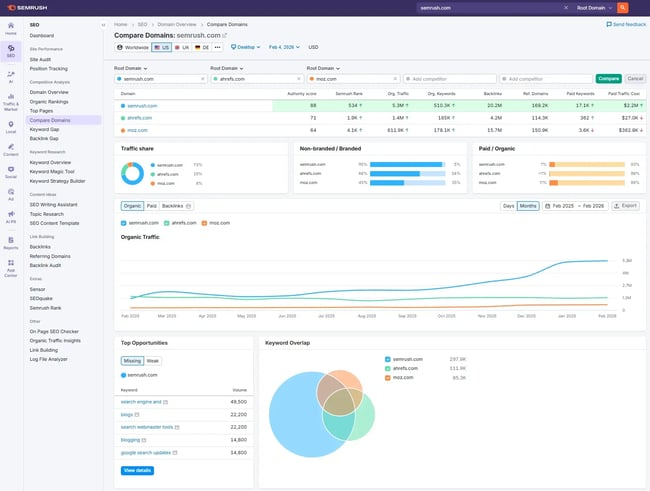
semrush is an seo competitor analysis tool. the screenshot shows how you can compare competitor domains.

Semrush is best for SEO competitor analysis, particularly for teams managing multiple competitors or markets. It’s a widely used platform and a staple for SEO. Recently, Semrush rebranded to Semrush One to better encapsulate what it is: one tool for all your search needs, from SEO to GEO and AI search. Semrush is especially strong for teams that want to understand the full competitive landscape — from keyword overlap to content strategy and AI visibility — without stitching together multiple tools.

Key features:

  • Competitive keyword and domain comparison to identify gaps and overlaps. You can directly compare your competitors against up to four others, and Semrush creates tables and reports showing with data, where you’re ahead or falling behind compared to competitors.
  • AI-assisted content and keyword suggestions, and AI visibility tracking that help teams uncover competitor topics and forecast visibility opportunities in GEO.
  • Reports like Position Tracking, Site Audit, and Prompt Tracking monitor your data so you can see how fluctuations in on-site and off-site SEO/GEO are affecting your site.

Pricing:

Semrush offers a free 7-day trial; after that, teams need to pay for access. Billed annually, costs are:

  • Starter: $165.17/month
  • Pro+: $248.17/month
  • Advanced: $455.67/month

What I like: I’m a big fan of Semrush. I’ve used it for many years. I think the user experience (UX) is really good and intuitive, and over the last year to eighteen months, I‘ve been impressed by how well Semrush has kept up with the changing search landscape, including AEO/GEO tools.

2. Ahrefs

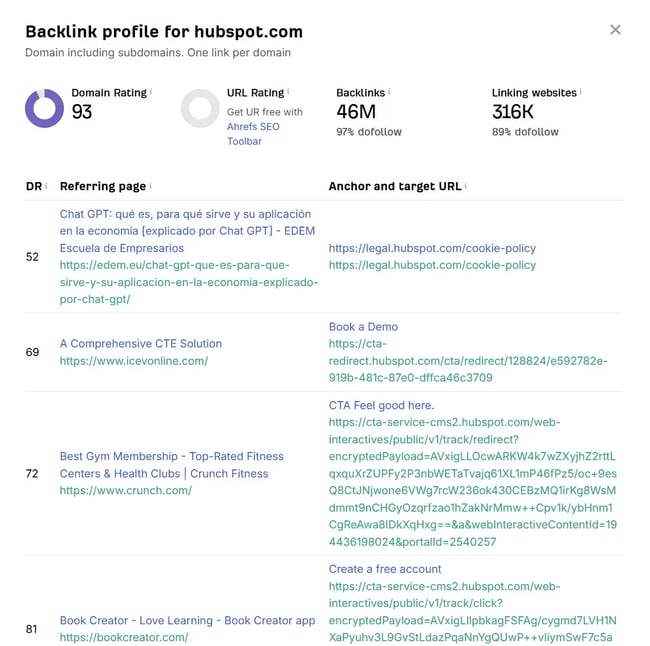
Screenshot from Ahref’s backlink tool, an SEO competitor analysis report that shows backlinks that competitors have earned.

Ahrefs is best known for its depth of data and its strength in backlink and content-led competitor analysis. It’s a go-to tool for SEO teams looking to understand why competitors outperform them. While Ahrefs has traditionally focused on classic organic search and backlinks, it’s increasingly useful for teams tracking modern GEO and AI-driven discovery.

Key features:

  • Deep backlink analysis that shows where competitors are earning authority, which links matter most, and where link gaps exist.
  • Content Explorer and Top Pages reports that surface competitors’ best-performing content, helping teams reverse-engineer formats, topics, and update opportunities.
  • Brand Radar Report tracks AI visibility across a number of LLM chatbots, so you can see how your site is appearing in AI search.

Pricing:

Ahrefs does not offer a free plan, but it does provide limited access via Ahrefs Webmaster Tools.

Paid plans start at:

  • Starter: $29/month
  • Lite: $129/month
  • Standard: $249/month
  • Advanced: $449/month
  • Enterprise: $1,499/month

Why marketing experts like Ahrefs: Lauren Schwartz, Digital Strategy Manager at Maid2Match, recommends using Ahrefs for competitor analysis with Site Explorer. She uses it to see the performance of a specific subfolder of a competitor’s website. It provides an overview of the competitor’s strategy and tactics, and whether they’re working. Schwartz says, “Ahrefs fills in the gaps to round out data gathered from Google Search Console, helping you make more informed SEO decisions.” Jimmy Hartill also rates Ahrefs. He says, “Ahrefs is good for position tracking and gap analysis. It's never going to be 100% accurate, but it is at least consistent for making judgment calls.”

3. Moz

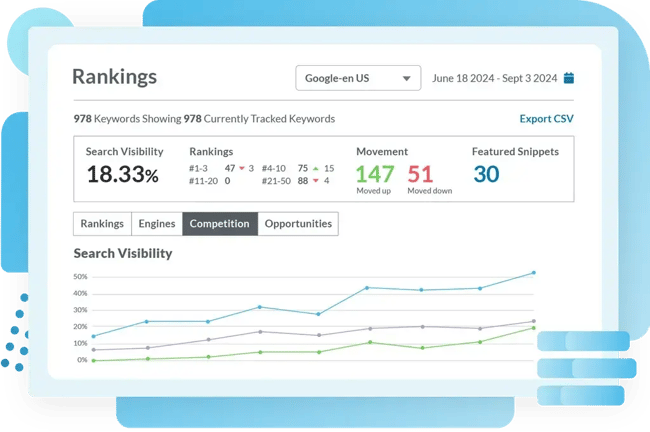
screenshot of moz’s competitor analysis dashboard comparing seo for

Source

Moz is a long-standing SEO platform that’s often favored by smaller in-house teams and agencies who need to benchmark competitors and prioritize opportunities. Moz isn’t as expansive as Semrush or Ahrefs, but it remains a dependable choice for SEO competitor analysis.

Key features:

  • Keyword and domain comparison tools that help teams identify ranking gaps, competitive difficulty, and realistic opportunities.
  • Domain Authority and Page Authority metrics for quick, high-level competitor benchmarking and trend tracking.
  • Rank tracking and on-page optimization insights that make it easier to monitor progress against competitors over time.

Pricing:

Moz offers a limited free tier. Paid plans start at:

  • Starter: $49/month
  • Standard: $99/month
  • Medium: $179/month
  • Large: $299/month

What I like: Moz is easy to trust and easy to use. The reports and metrics are easy to understand, and for teams that want a solid SEO competitor analysis tool without a steep learning curve, Moz still holds its own.

What experts like about Moz: Lydia Fox, Head of SEO at Serpify, says, “I use MOZ practically every single day. One of my favourite tools they offer is their Chrome extension, which lets you view links and quickly see which are internal, nofollow, or do-follow, making on-page analysis super easy. I also love the link analysis, and pay attention to spam score when evaluating domains for potential off-page collaborations."

Interested in reviewing other tools that let you spy on competitors' traffic? Read What is Competitor Keyword Analysis? 6 Best Tools for the Job

Social Media Competitor Analysis Tools

Keeping tabs on competitors on social media isn’t about vanity metrics — it’s about understanding how they show up, what resonates with their audience, and how their messaging evolves. Social media competitor analysis tools help marketing teams track competitor activity across platforms to spot trends early, adapt content strategies, and stay one step ahead.

4. HubSpot

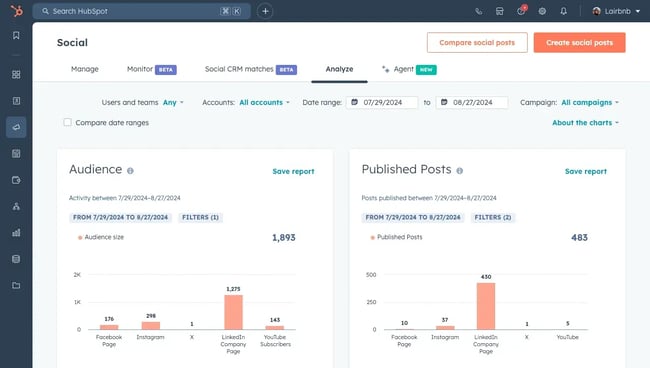
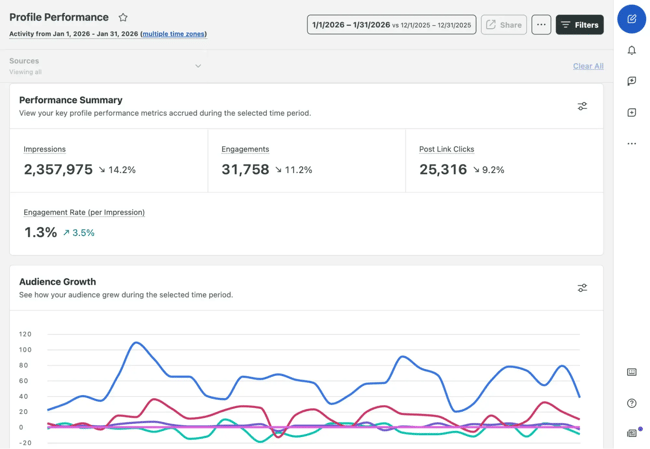
screenshot from hubspot’s social media competitor analysis tool showing audience and post reports.

HubSpot's social media tools are best suited for teams already using its CRM and marketing platform because they provide comprehensive competitor insights and are best combined with broader marketing operations within Marketing Hub.

Pro Tip: This video shows you how to set up and monitor competitor streams for social media

HubSpot offers so much more than social media competitor analysis. It connects social insights directly to customer data, campaigns, and reporting dashboards — making it particularly valuable for teams that prioritize unified data and streamlined workflows.

Key features:

  • Social media monitoring and competitor tracking that lets you follow competitor accounts, track their posting frequency, and benchmark engagement metrics alongside your own performance.
  • Integrated reporting that pulls social competitor data into the same dashboards as your CRM, email campaigns, and content performance, creating a single source of truth for marketing teams.
  • Content strategy tools that analyze competitor posts and suggest optimal posting times, formats, and topics based on what's performing well in your industry.

Pricing:

HubSpot's social tools are included in the Marketing Hub. You can access limited features with the free tier, then paid plans (billed annually) start from:

  • Starter: $15/month
  • Professional: $890/month
  • Enterprise: $3,600/month

What I like: I love how centralized everything is on Marketing Hub, including its social competitor analysis. It makes it easier to connect the dots between competitors' actions and how they should inform your strategy. In addition, HubSpot and Marketing Hub are far beyond just a social media competitor analysis tool. One investment into HubSpot’s tools can save hundreds — even thousands — by replacing multiple point solutions. For example, teams often use HubSpot instead of paying separately for social scheduling, competitor analysis tools, marketing platforms, landing page builders, and more.

What experts love about HubSpot: I’m not the only one who rates HubSpot. Jenny Bernarde, Brand and Communications Manager, BrightLocal, says, “One of the best features of HubSpot’s social media tool is the scheduling tool. It’s clearly laid out, easy to use, and provides accurate previews for each channel. The AI generation feature is helpful to edit my work, and the in-platform video editing tool makes sharing videos easier than ever.”

5. Sprout Social

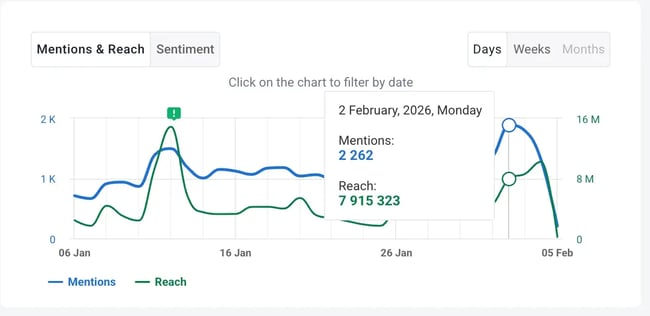
Screenshot from Sprout Social, a social media competitor analysis, showing reports for audience growth.

Sprout Social is a comprehensive social media management tool that includes deep competitor insights, expected scheduling tools, and more sophisticated monitoring, such as sentiment analysis and audience intelligence. Sprout Social helps social media marketers understand what competitors are posting, how audiences are responding, and what content strategies are actually driving engagement.

Key features:

  • Competitive reports that track competitor performance across platforms, including follower growth, engagement rates, post frequency, and content type analysis, all visualized in easy-to-digest dashboards.
  • Social listening capabilities that monitor competitor brand mentions, hashtags, and industry keywords to surface trends, sentiment shifts, and emerging opportunities before they become obvious.
  • Message Spike Alerts and trend identification that notify teams when competitors experience sudden engagement changes or viral moments, helping you understand what's resonating in real-time.

Pricing:

Sprout Social offers a 30-day free trial with no credit card required.

Paid plans (billed annually) start from:

  • Standard: $199/month
  • Professional: $299/month
  • Advanced: $399/month
  • Enterprise: Custom pricing

What I like: Sprout Social's reporting is exceptionally clean and presentation-ready, which matters when you need to quickly share competitor insights with stakeholders or clients. I’ve worked in an agency as a project manager balancing multiple clients, so I know the value of a quick-turn report that looks good.

6. Brand24

screenshot from brand24, a social media competitor analysis tool.

Brand24 helps social media marketers prioritize real-time social listening and brand monitoring. It‘s particularly strong for tracking competitor mentions, brand sentiment, and emerging conversations across social platforms, blogs, forums, and news sites. Unlike broader social tools, Brand24 focuses specifically on what’s being said about you, your competitors — and by extension, your market — making it ideal for reputation monitoring and competitive intelligence.

Key features:

  • Real-time mention tracking across social media, blogs, forums, podcasts, and news sites that captures competitor brand mentions, product feedback, and customer sentiment as conversations happen.
  • Sentiment analysis and discussion volume metrics that help teams gauge how audiences feel about competitors and identify shifts in brand perception or emerging crises.
  • Influencer identification and reach analysis that shows who‘s talking about your competitors, how much influence they have, and what narratives they’re shaping in your industry.

Pricing:

Brand24 offers a 14-day free trial. Paid plans with annual billing start from:

  • Individual: $149/month
  • Team: $249/month
  • Pro: $299/month
  • Business: $499/month
  • Enterprise: $1,499/month

What experts love about Brand24: Bernarde also uses Brand24 to track brand mentions. She says, “Its AI Brand Assistant is a quick way to delve into your data, pull out certain mentions from campaigns, and its recommendations make it easy to plan next steps in our brand marketing.

PPC Competitor Analysis Tools

Paid media teams need to know who they’re bidding against, how aggressive competitors are, and how messaging shifts over time. The tools below are the ones marketing teams rely on for PPC competitive analysis, enabling smarter bidding and creative decisions.

7. SpyFu

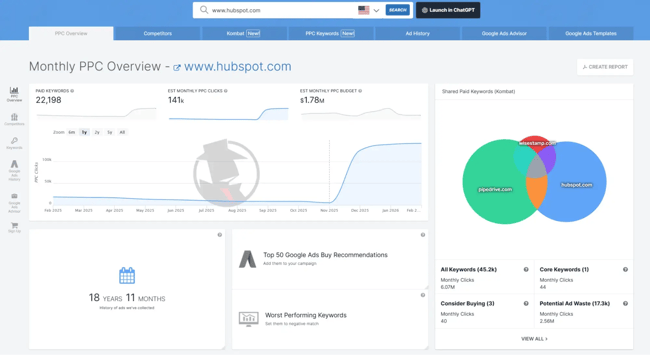
screenshot from ppc competitor analysis tool, spyfu, showing the monthly ppc overview and kombat report.

SpyFu is a specialized tool for paid search and competitive keyword research. It’s designed to answer very practical PPC questions quickly: who’s bidding on what, how long they’ve been doing it, and which keywords and ads are worth paying attention to. SpyFu is best for PPC competitor analysis, particularly for teams that want fast, actionable insight without enterprise complexity.

Key features:

  • Competitor keyword research shows who bids on which terms and how aggressively.
  • Historical ad copy and keyword data to identify long-running, proven campaigns.
  • Kombat reports that reveal shared and unique keywords across multiple competitors.

Pricing: SpyFu offers limited free access. Billed annually, paid plans start at:

  • Basic: $29/month
  • Pro + AI: $89/month
  • Team: $187/month

Why marketing experts like SpyFu: Leigh Buttrey and I co-founded a boutique SEM agency, forank, Leigh manages all things PPC, so I asked her what she likes about SpyFu. Buttrey says, “Spyfu is fairly lightweight and affordable, which makes it a great entry-level competitor analysis tool for PPC marketers. It’s fast, easy to use, and it cuts through noise, highlighting what competitors are actually spending money on, making it easier to prioritize tests and spot opportunities early.”

8. Google Ads Auction Insights

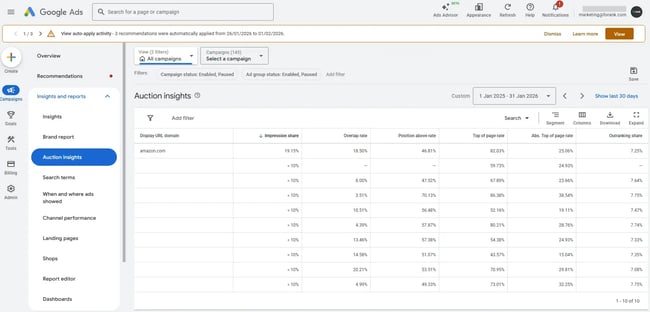
screenshot from google ads auction insights, a ppc competitor research tool, showing how the tool shares competitive context about ads and competitive performance.

Google Ads Auction Insights is a built-in report that shows how your ads perform relative to other advertisers in the same auctions. To see Google Ads Auction Insights within the Google Ads platform, you need to have ads running. While the report doesn’t expose keywords or ad copy, it provides direct competitive context from Google. PPC experts use Google Ads Auction Insights to make strategic bidding and budgeting decisions by analyzing where their account is performing and where opportunities are missed.

Key features:

  • Impression share, overlap rate, and outranking share against competing advertisers.
  • Visibility into how often competitors appear above you in auctions.
  • Time-based comparisons to track competitive pressure and market shifts.

Pricing:Free forever

Why marketing experts like Google Ads Auction Insights: Buttrey says, “Auction Insights is essential because it’s first-party data straight from Google. It shows you competitive pressure in real time — who’s outranking you, how often they appear, and when the market is getting more aggressive. I use it to sense-check third-party tools and to understand whether performance changes are caused by bidding behavior, not campaign setup.”

Content and Influencer Analysis Tools

Content and influencer competitor analysis helps teams understand what’s actually influencing audiences, not just what competitors are publishing. These tools reveal which topics, formats, and creators are driving engagement and trust, making it easier to reverse-engineer successful strategies and avoid chasing vanity metrics.

9. BuzzSumo

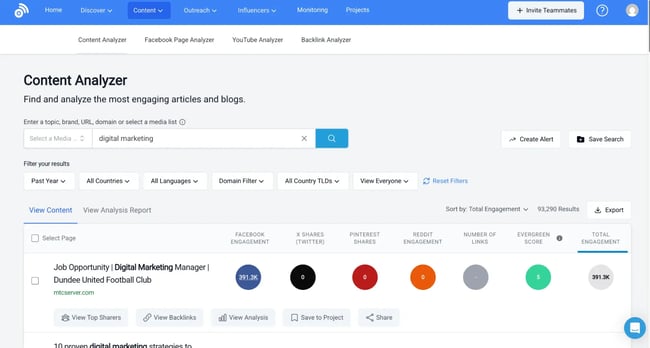
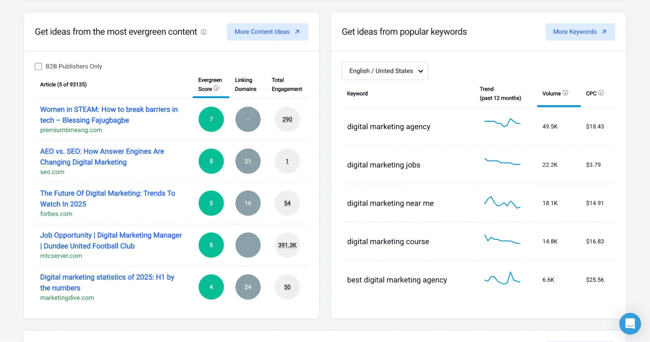
screenshot from buzzsumo, a content and influencer analysis tool

Screenshot from Buzzsumo, a content and influencer analysis tool

BuzzSumo is a content research and analysis platform that reveals which competitor content is performing best across social channels, who‘s sharing it, and why it’s resonating. Marketing teams rely on BuzzSumo to reverse-engineer successful content strategies, identify content gaps, and discover the influencers and publishers amplifying competitor messages.

Key features:

  • Content analysis that shows top-performing competitor articles, videos, and posts ranked by social engagement, backlinks, and evergreen score, helping teams identify winning topics and formats worth replicating.
  • Influencer and journalist discovery tools that reveal who's sharing and linking to competitor content, making it easier to build relationships with the same voices amplifying your competition.
  • Trending topics and question analyzer that surfaces real-time content opportunities and common questions in your niche, showing what audiences are actively searching for and discussing before competitors capitalize on it.

Pricing:

BuzzSumo offers a 7-day free trial. Paid plans, billed annually, start from:

  • Content Creation: $159/month
  • PR & Comms: $239/month
  • Suite: $399/month
  • Enterprise: $999/month

What I like: BuzzSumo is a tool that benefits all of marketing, not just social media. While it is excellent for social media and influence, you can also use it to generate ideas for your overall content strategy and the types of messaging that are trending in your industry.

10. HypeAuditor

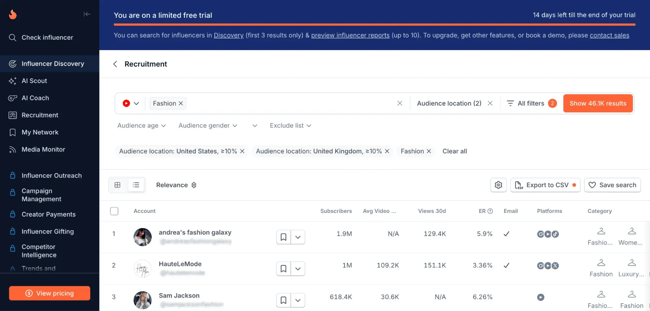
Screenshot from hyperauditor, a content and influencer analysis tool

HypeAuditor is an AI-powered influencer analytics platform that reveals audience quality, engagement authenticity, and fraud detection. Marketing teams use HypeAuditor to understand which influencers competitors are working with, whether those partnerships are delivering real value, and how to build more effective influencer strategies based on verified data rather than vanity metrics.

Key features:

  • Influencer fraud detection and audience quality analysis that identifies fake followers, engagement pods, and bot activity, helping teams avoid wasting budget on influencers with inflated metrics and ensuring competitor partnerships are as successful as they appear.
  • Competitor influencer tracking that shows which creators are promoting competitor products, how often they post, what engagement they're generating, and estimated campaign costs, giving you a complete view of competitor influencer strategies.
  • Market analysis and benchmarking reports that compare influencer performance across your industry, revealing average engagement rates, audience demographics, and content formats that drive the best ROI for similar brands.

Pricing:

HypeAuditor offers a demo, but there’s no pricing on their website; it’s all custom. Book a free demo to enquire about pricing.

Market Intelligence and Pricing Tools

Competitive intelligence tools help teams stay informed without drowning in noise. Instead of manual research or one-off reports, these platforms surface timely signals and trends that can influence messaging, positioning, pricing conversations, and go-to-market decisions.

11. Owler

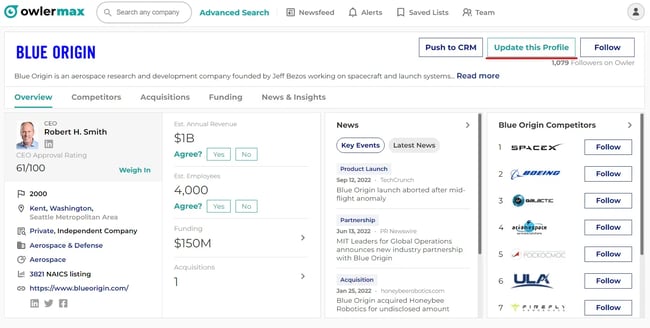
screenshot from owler, a competitive intelligence tool.

Source

Owler is an affordable business intelligence platform that tracks competitor news, funding, leadership changes, and company growth signals in real-time. Marketing teams use Owler to stay informed about competitors, including acquisitions, product launches, and executive hires that could signal shifts in strategy or market positioning, making it easier to spot opportunities.

Key features:

  • Real-time competitor news alerts and company updates that deliver notifications about competitor funding rounds, leadership changes, mergers, acquisitions, and product announcements directly to your inbox or Slack.
  • Company profiles with revenue estimates, employee counts, competitor lists, and growth metrics that provide a high-level snapshot of competitive positioning and market share without requiring deep research.
  • Competitive insights feed that surfaces trending companies in your industry, tracks follower activity, and highlights which competitors are gaining momentum or losing ground in public perception.

Pricing: Owler offers a limited free tier. Paid plans start from:

  • Pro: $39/month
  • Enterprise: Custom pricing

12. Morning Consult

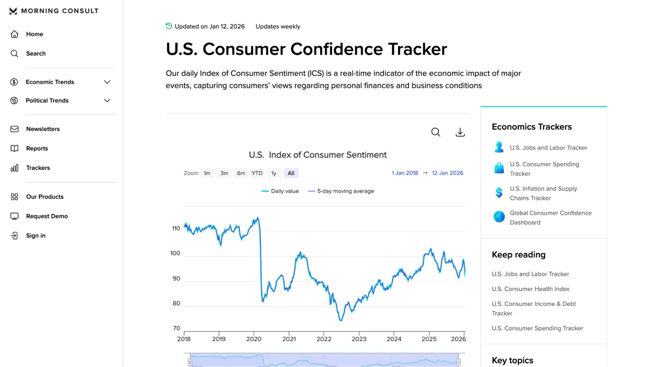
screenshot from my account in Morning Consult, a competitive intelligence tool.

Morning Consult helps enterprise brands and agencies access data-driven insights into brand perception and consumer sentiment at scale. It's a market intelligence platform that uses real-time polling and survey data to track brand health, competitive positioning, and audience sentiment across demographics and markets. Marketing teams rely on Morning Consult to understand how their brand stacks up against competitors in the eyes of actual consumers — not just through social listening or web analytics, but through direct feedback that reveals awareness, consideration, and trust metrics that drive purchase decisions.

Key features:

  • Brand tracking and competitive benchmarking that measures brand awareness, favorability, consideration, and purchase intent against competitors across key demographics, helping teams identify perception gaps and positioning opportunities.
  • Consumer sentiment analysis and trend forecasting that captures real-time shifts in public opinion about competitors, industries, and market dynamics through continuous polling of targeted audiences.
  • Custom research capabilities and audience segmentation that allow teams to drill into specific customer segments, test messaging concepts, and validate strategic decisions with proprietary data tailored to their competitive landscape.

Pricing: Morning Consult does not publicly list pricing. Plans are customized based on research needs, audience size, and tracking frequency. Teams will need to book a demo to access prices.

Free Search and Web Tools

Free tools can be surprisingly powerful, especially when teams want data, insights, or validation on assumptions before investing in paid platforms. The tools below genuinely rival paid platforms in depth and reliability, and when used well, they can form the backbone of a highly effective competitive workflow. That’s why they’re often the first place teams start when budgets are tight — and the last tools they stop using, even as stacks grow.

13. Google Search Console

screenshot from google search console’s interface.

Google Search Console (GSC) is one of the most underrated tools for SEO, not because it shows competitor data directly, but because it reveals where you’re already competing. By analyzing impressions, queries, and pages, teams can review SERPs and see which competitors appear alongside them in search results and where visibility is being gained or lost.

Key features:

  • Search performance reports showing queries, impressions, clicks, and ranking trends over time. The great thing about this report is that it is the real, source data about your site, not third-party data.
  • Technical signals like indexing, Core Web Vitals, and crawl issues that affect competitive visibility are all within Google Search Console, and the platform shows you where errors are, too.
  • Links report details all of your internal links so you can see which pages have the most links, and which have few or none.

Pricing: Free forever.

What I like: I love GSC because it’s your source data; it’s reality. It’s first-party data from Google, making it invaluable. You can uncover an incredible amount of information for free — especially in the Performance report, where you can see the actual queries your site appeared for in SERPs, along with impressions, clicks, and trends over time. It’s a goldmine because it shows the real keywords people are using to find you, including long-tail and emerging queries that often don’t appear in paid tools like Semrush, Moz, or Ahrefs.

14. HubSpot AI Search Grader

screenshot from an aeo grader, a free competitor analysis tool, showing how the tool can be used to review ai search visibility, brand sentiment, and more. you can use it as a competitor research tool for reviewing competitor domains.

HubSpot’s AI Search Grader is designed for the new era of search, where visibility isn’t limited to blue links. AI Search Grader is a free tool for checking AI search visibility, helping teams understand how their brand — and their competitors — appear in large language model (LLM) answers and AI-powered search experiences.

Teams can plug in competitor domains to compare them to their own domain, making it one of the most practical free competitor analysis tools for GEO and AI search.

Key features:

  • Visibility scoring for AI-generated search and LLM answers, giving teams a clear, comparable view of how often their brand appears in AI-driven responses across emerging search experiences.
  • Competitor comparisons that show relative presence in AI responses, allowing teams to benchmark themselves against direct competitors and spot gaps in AI visibility, authority, and coverage.
  • Actionable recommendations tied to HubSpot’s AEO (Answer Engine Optimization) framework, helping teams translate visibility gaps into concrete next steps for improving how content is understood and surfaced by AI systems.

Pro Tip: If you want more support understanding AEO, HubSpot has a complete AEO guide here.

Pricing:Free forever.

What I like: For a free AI search tool, I think AEO Search Grader is excellent! It makes AI search measurable. It’s quick, genuinely useful, and a great way to start conversations about GEO without overcomplicating things. For marketers experimenting with AI visibility, it’s an easy win.

Frequently Asked Questions About Competitor Analysis Tools

What is the simplest free stack to start with?

Start with Google Search Console for first-party search data, Google Ads Auction Insights for paid visibility signals, and HubSpot’s AI Search Grader to understand AI and GEO presence. Together, these give you a clear picture of where you’re competing today — across classic search, paid, and AI — all without spending anything.

How often should we run competitor analysis?

Competitor analysis should be ongoing. With tools like Semrush or Ahrefs, you can run competitor analysis in the background. SEO teams can conduct deeper analysis at regular intervals, such as quarterly, biannually, or annually. The goal isn’t constant, manual auditing — it’s staying alert to meaningful changes.

Is it legal to monitor ads, emails, and social posts from competitors?

Yes, it’s legal to monitor ads, email marketing, and social posts from competitors as long as you’re observing publicly available information and not accessing private systems. Teams should validate data accuracy and respect privacy when using competitor analysis tools.

How can we keep insights from getting siloed?

Centralize findings in a shared system — ideally your CRM — so insights connect to campaigns, content, and revenue. AI summaries and regular reviews help keep competitive data actionable rather than forgotten.

When should we move from spreadsheets to a competitive intelligence platform?

Consider moving from spreadsheets to competitive intelligence platforms as soon as possible, because the tools will offer so much data and expedited workflows. If competitor tracking becomes ongoing, multi-channel, or shared across teams, spreadsheets slow down decision-making and lead to data errors.

Turning Insight From Competitor Analysis Tools Into Competitive Advantage

Competitor analysis only works when it’s operational. The tools marketing teams actually use aren’t just good at collecting data — they help teams compare competitors across SEO, social, PPC, and market intelligence, then turn those insights into decisions. The most effective stacks combine best-in-class specialist tools with a central system — like HubSpot CRM — where insights can be shared, tracked, and acted on over time.

Speaking from experience, I’ve used most of these tools in real-world SEO and marketing workflows, and I genuinely believe you can do a lot before spending a penny. Google Search Console, Google Ads Auction Insights, and HubSpot’s AI Search Grader are incredibly powerful free tools, especially when budgets are tight or teams are just getting started with competitive research.

My advice is always the same: start with the free tools, then try paid platforms to see which actually fit your goals, your team, and your workflows. The best competitor analysis stack is the one your team will keep using — even as it evolves.


from Marketing https://blog.hubspot.com/marketing/competitor-analysis-tools

Competitor analysis tools are software platforms that help marketing teams monitor and compare competitor strategies across SEO, social, PPC, and market intelligence. Think of them as marketer’s best friend: they expedite the competitor analysis process, so you can see where your competition is making moves (and where the gaps are wide open). The best tools work passively, updating in the background while you focus on moving the needle for your business. → Download Now: SEO Starter Pack [Free Kit]

I’ve worked in digital marketing for nearly 20 years, with more than a decade focused on SEO. In that time, I’ve tested — and retired — a lot of marketing tools. In this article, I round up 14 competitor analysis tools that marketing teams actually use, grouped by marketing category, from SEO and paid media to social and market intelligence.

For each tool, I break down its key features, pricing, and what I genuinely like about using it. Where my hands-on experience is limited, I’ve brought in perspectives from industry experts who rely on these platforms day-to-day, sharing how they use them and why they rate them.

Table of Contents

What to look for in competitor analysis tools.

The best competitor analysis tools aren’t necessarily the ones with the most features, or the most expensive; they’re the tools that give your business the data it needs, while inspiring your team to use them.

In practice, that means tools align to a clear goal, fit naturally into existing workflows, and make it easy to turn insight into action.

The best tools are accurate, regularly updated, and built for side-by-side comparison. Just as importantly, insights shouldn’t live in isolation — competitor insights should be centralized in CRM for unified reporting and action, so they can inform campaigns, content, and sales conversations. Any new tools should integrate cleanly into an existing tech stack.

Below are extra tips for each channel to help teams choose the right tools for their specific needs.

  • SEO: Look for tools that clearly show keyword overlap, ranking movement, and content gaps, so Search Engine Optimization (SEO) teams can prioritize where to defend positions and where to challenge competitors. Ideally, the SEO tool will already include features and reports for Generative Engine Optimization (GEO), such as prompt tracking and recommendations to improve visibility in AI tools.
  • Social media: Prioritize platforms that surface engagement trends, content formats, and posting frequency, helping teams understand what’s resonating rather than just who has the biggest audience.
  • PPC: Choose tools that reveal competitor ad copy, keyword strategy, and budget signals, enabling paid teams to spot testing patterns and shifts in bidding behavior early.
  • Market intelligence: Focus on tools that track broader signals like positioning, pricing, product launches, and brand sentiment. Ideally, the tool is supported by AI copilots that summarize findings and generate action plans from competitor data.

Pro Tip: If you want to master the basics of competitor analysis, read HubSpot’s competitor analysis guide, where you’ll also find a downloadable template.

The Best Competitor Analysis Tools By Category

There’s a detailed breakdown of every tool below, but here’s an overview:

Tool

Category

Standout Feature

Best For

Semrush

SEO / GEO / AEO

Side-by-side competitor domain & keyword comparison (plus AI/GEO tracking)

SEO teams managing multiple competitors, markets, or AI visibility

Ahrefs

SEO

Deep backlink intelligence and content gap analysis

SEO teams focused on authority, links, and content-led growth

Moz

SEO

Simple, trusted metrics like Domain Authority

Smaller teams that want dependable SEO benchmarking without complexity

HubSpot

Social / CRM

Social competitor insights tied directly to CRM and campaigns

Teams already using HubSpot who want centralized competitor data

Sprout Social

Social

Clean, presentation-ready competitor and sentiment reports

Social teams reporting to stakeholders or clients

Brand24

Social / Brand Monitoring

Real-time competitor mentions and sentiment analysis

Teams focused on reputation, PR, and brand perception

SpyFu

PPC

Historical ad copy and long-running keyword intelligence

PPC teams who want fast, actionable competitor insights

Google Ads (Auction Insights)

PPC

First-party competitive auction data

Paid media teams needing real-time competitive pressure signals

BuzzSumo

Content / Influencer

Identifies top-performing competitor content and who amplifies it

Content, PR, and social teams shaping messaging and formats

HypeAuditor

Influencer

Fraud detection and audience authenticity scoring

Brands evaluating competitor influencer partnerships

Owler

Market Intelligence

Real-time competitor news and company updates

Marketing and sales teams tracking strategic competitor moves

Morning Consult

Market Intelligence

Consumer sentiment and brand perception polling

Enterprise teams needing perception-led competitive insights

Google Search Console

SEO (Free)

First-party search performance and query data

Any team wanting reliable, zero-cost SEO insights

HubSpot AI Search Grader

GEO / AEO (Free)

Measures competitor visibility in AI-generated answers

Teams experimenting with AI search and AEO

SEO Competitor Analysis Tools

SEO competitor analysis is foundational to marketing. SEO insights provide marketing teams with information about client strategy, audience pain points, and opportunities to get visibility when your prospects are asking for it. By looking at search engine results pages, SEO uncovers direct and indirect competitors, and the findings may be surprising since indirect competitors in particular often fly under the radar.

1. Semrush

semrush is an seo competitor analysis tool. the screenshot shows how you can compare competitor domains.

Semrush is best for SEO competitor analysis, particularly for teams managing multiple competitors or markets. It’s a widely used platform and a staple for SEO. Recently, Semrush rebranded to Semrush One to better encapsulate what it is: one tool for all your search needs, from SEO to GEO and AI search. Semrush is especially strong for teams that want to understand the full competitive landscape — from keyword overlap to content strategy and AI visibility — without stitching together multiple tools.

Key features:

  • Competitive keyword and domain comparison to identify gaps and overlaps. You can directly compare your competitors against up to four others, and Semrush creates tables and reports showing with data, where you’re ahead or falling behind compared to competitors.
  • AI-assisted content and keyword suggestions, and AI visibility tracking that help teams uncover competitor topics and forecast visibility opportunities in GEO.
  • Reports like Position Tracking, Site Audit, and Prompt Tracking monitor your data so you can see how fluctuations in on-site and off-site SEO/GEO are affecting your site.

Pricing:

Semrush offers a free 7-day trial; after that, teams need to pay for access. Billed annually, costs are:

  • Starter: $165.17/month
  • Pro+: $248.17/month
  • Advanced: $455.67/month

What I like: I’m a big fan of Semrush. I’ve used it for many years. I think the user experience (UX) is really good and intuitive, and over the last year to eighteen months, I‘ve been impressed by how well Semrush has kept up with the changing search landscape, including AEO/GEO tools.

2. Ahrefs

Screenshot from Ahref’s backlink tool, an SEO competitor analysis report that shows backlinks that competitors have earned.

Ahrefs is best known for its depth of data and its strength in backlink and content-led competitor analysis. It’s a go-to tool for SEO teams looking to understand why competitors outperform them. While Ahrefs has traditionally focused on classic organic search and backlinks, it’s increasingly useful for teams tracking modern GEO and AI-driven discovery.

Key features:

  • Deep backlink analysis that shows where competitors are earning authority, which links matter most, and where link gaps exist.
  • Content Explorer and Top Pages reports that surface competitors’ best-performing content, helping teams reverse-engineer formats, topics, and update opportunities.
  • Brand Radar Report tracks AI visibility across a number of LLM chatbots, so you can see how your site is appearing in AI search.

Pricing:

Ahrefs does not offer a free plan, but it does provide limited access via Ahrefs Webmaster Tools.

Paid plans start at:

  • Starter: $29/month
  • Lite: $129/month
  • Standard: $249/month
  • Advanced: $449/month
  • Enterprise: $1,499/month

Why marketing experts like Ahrefs: Lauren Schwartz, Digital Strategy Manager at Maid2Match, recommends using Ahrefs for competitor analysis with Site Explorer. She uses it to see the performance of a specific subfolder of a competitor’s website. It provides an overview of the competitor’s strategy and tactics, and whether they’re working. Schwartz says, “Ahrefs fills in the gaps to round out data gathered from Google Search Console, helping you make more informed SEO decisions.” Jimmy Hartill also rates Ahrefs. He says, “Ahrefs is good for position tracking and gap analysis. It's never going to be 100% accurate, but it is at least consistent for making judgment calls.”

3. Moz

screenshot of moz’s competitor analysis dashboard comparing seo for

Source

Moz is a long-standing SEO platform that’s often favored by smaller in-house teams and agencies who need to benchmark competitors and prioritize opportunities. Moz isn’t as expansive as Semrush or Ahrefs, but it remains a dependable choice for SEO competitor analysis.

Key features:

  • Keyword and domain comparison tools that help teams identify ranking gaps, competitive difficulty, and realistic opportunities.
  • Domain Authority and Page Authority metrics for quick, high-level competitor benchmarking and trend tracking.
  • Rank tracking and on-page optimization insights that make it easier to monitor progress against competitors over time.

Pricing:

Moz offers a limited free tier. Paid plans start at:

  • Starter: $49/month
  • Standard: $99/month
  • Medium: $179/month
  • Large: $299/month

What I like: Moz is easy to trust and easy to use. The reports and metrics are easy to understand, and for teams that want a solid SEO competitor analysis tool without a steep learning curve, Moz still holds its own.

What experts like about Moz: Lydia Fox, Head of SEO at Serpify, says, “I use MOZ practically every single day. One of my favourite tools they offer is their Chrome extension, which lets you view links and quickly see which are internal, nofollow, or do-follow, making on-page analysis super easy. I also love the link analysis, and pay attention to spam score when evaluating domains for potential off-page collaborations."

Interested in reviewing other tools that let you spy on competitors' traffic? Read What is Competitor Keyword Analysis? 6 Best Tools for the Job

Social Media Competitor Analysis Tools

Keeping tabs on competitors on social media isn’t about vanity metrics — it’s about understanding how they show up, what resonates with their audience, and how their messaging evolves. Social media competitor analysis tools help marketing teams track competitor activity across platforms to spot trends early, adapt content strategies, and stay one step ahead.

4. HubSpot

screenshot from hubspot’s social media competitor analysis tool showing audience and post reports.

HubSpot's social media tools are best suited for teams already using its CRM and marketing platform because they provide comprehensive competitor insights and are best combined with broader marketing operations within Marketing Hub.

Pro Tip: This video shows you how to set up and monitor competitor streams for social media

HubSpot offers so much more than social media competitor analysis. It connects social insights directly to customer data, campaigns, and reporting dashboards — making it particularly valuable for teams that prioritize unified data and streamlined workflows.

Key features:

  • Social media monitoring and competitor tracking that lets you follow competitor accounts, track their posting frequency, and benchmark engagement metrics alongside your own performance.
  • Integrated reporting that pulls social competitor data into the same dashboards as your CRM, email campaigns, and content performance, creating a single source of truth for marketing teams.
  • Content strategy tools that analyze competitor posts and suggest optimal posting times, formats, and topics based on what's performing well in your industry.

Pricing:

HubSpot's social tools are included in the Marketing Hub. You can access limited features with the free tier, then paid plans (billed annually) start from:

  • Starter: $15/month
  • Professional: $890/month
  • Enterprise: $3,600/month

What I like: I love how centralized everything is on Marketing Hub, including its social competitor analysis. It makes it easier to connect the dots between competitors' actions and how they should inform your strategy. In addition, HubSpot and Marketing Hub are far beyond just a social media competitor analysis tool. One investment into HubSpot’s tools can save hundreds — even thousands — by replacing multiple point solutions. For example, teams often use HubSpot instead of paying separately for social scheduling, competitor analysis tools, marketing platforms, landing page builders, and more.

What experts love about HubSpot: I’m not the only one who rates HubSpot. Jenny Bernarde, Brand and Communications Manager, BrightLocal, says, “One of the best features of HubSpot’s social media tool is the scheduling tool. It’s clearly laid out, easy to use, and provides accurate previews for each channel. The AI generation feature is helpful to edit my work, and the in-platform video editing tool makes sharing videos easier than ever.”

5. Sprout Social

Screenshot from Sprout Social, a social media competitor analysis, showing reports for audience growth.

Sprout Social is a comprehensive social media management tool that includes deep competitor insights, expected scheduling tools, and more sophisticated monitoring, such as sentiment analysis and audience intelligence. Sprout Social helps social media marketers understand what competitors are posting, how audiences are responding, and what content strategies are actually driving engagement.

Key features:

  • Competitive reports that track competitor performance across platforms, including follower growth, engagement rates, post frequency, and content type analysis, all visualized in easy-to-digest dashboards.
  • Social listening capabilities that monitor competitor brand mentions, hashtags, and industry keywords to surface trends, sentiment shifts, and emerging opportunities before they become obvious.
  • Message Spike Alerts and trend identification that notify teams when competitors experience sudden engagement changes or viral moments, helping you understand what's resonating in real-time.

Pricing:

Sprout Social offers a 30-day free trial with no credit card required.

Paid plans (billed annually) start from:

  • Standard: $199/month
  • Professional: $299/month
  • Advanced: $399/month
  • Enterprise: Custom pricing

What I like: Sprout Social's reporting is exceptionally clean and presentation-ready, which matters when you need to quickly share competitor insights with stakeholders or clients. I’ve worked in an agency as a project manager balancing multiple clients, so I know the value of a quick-turn report that looks good.

6. Brand24

screenshot from brand24, a social media competitor analysis tool.

Brand24 helps social media marketers prioritize real-time social listening and brand monitoring. It‘s particularly strong for tracking competitor mentions, brand sentiment, and emerging conversations across social platforms, blogs, forums, and news sites. Unlike broader social tools, Brand24 focuses specifically on what’s being said about you, your competitors — and by extension, your market — making it ideal for reputation monitoring and competitive intelligence.

Key features:

  • Real-time mention tracking across social media, blogs, forums, podcasts, and news sites that captures competitor brand mentions, product feedback, and customer sentiment as conversations happen.
  • Sentiment analysis and discussion volume metrics that help teams gauge how audiences feel about competitors and identify shifts in brand perception or emerging crises.
  • Influencer identification and reach analysis that shows who‘s talking about your competitors, how much influence they have, and what narratives they’re shaping in your industry.

Pricing:

Brand24 offers a 14-day free trial. Paid plans with annual billing start from:

  • Individual: $149/month
  • Team: $249/month
  • Pro: $299/month
  • Business: $499/month
  • Enterprise: $1,499/month

What experts love about Brand24: Bernarde also uses Brand24 to track brand mentions. She says, “Its AI Brand Assistant is a quick way to delve into your data, pull out certain mentions from campaigns, and its recommendations make it easy to plan next steps in our brand marketing.

PPC Competitor Analysis Tools

Paid media teams need to know who they’re bidding against, how aggressive competitors are, and how messaging shifts over time. The tools below are the ones marketing teams rely on for PPC competitive analysis, enabling smarter bidding and creative decisions.

7. SpyFu

screenshot from ppc competitor analysis tool, spyfu, showing the monthly ppc overview and kombat report.

SpyFu is a specialized tool for paid search and competitive keyword research. It’s designed to answer very practical PPC questions quickly: who’s bidding on what, how long they’ve been doing it, and which keywords and ads are worth paying attention to. SpyFu is best for PPC competitor analysis, particularly for teams that want fast, actionable insight without enterprise complexity.

Key features:

  • Competitor keyword research shows who bids on which terms and how aggressively.
  • Historical ad copy and keyword data to identify long-running, proven campaigns.
  • Kombat reports that reveal shared and unique keywords across multiple competitors.

Pricing: SpyFu offers limited free access. Billed annually, paid plans start at:

  • Basic: $29/month
  • Pro + AI: $89/month
  • Team: $187/month

Why marketing experts like SpyFu: Leigh Buttrey and I co-founded a boutique SEM agency, forank, Leigh manages all things PPC, so I asked her what she likes about SpyFu. Buttrey says, “Spyfu is fairly lightweight and affordable, which makes it a great entry-level competitor analysis tool for PPC marketers. It’s fast, easy to use, and it cuts through noise, highlighting what competitors are actually spending money on, making it easier to prioritize tests and spot opportunities early.”

8. Google Ads Auction Insights

screenshot from google ads auction insights, a ppc competitor research tool, showing how the tool shares competitive context about ads and competitive performance.

Google Ads Auction Insights is a built-in report that shows how your ads perform relative to other advertisers in the same auctions. To see Google Ads Auction Insights within the Google Ads platform, you need to have ads running. While the report doesn’t expose keywords or ad copy, it provides direct competitive context from Google. PPC experts use Google Ads Auction Insights to make strategic bidding and budgeting decisions by analyzing where their account is performing and where opportunities are missed.

Key features:

  • Impression share, overlap rate, and outranking share against competing advertisers.
  • Visibility into how often competitors appear above you in auctions.
  • Time-based comparisons to track competitive pressure and market shifts.

Pricing:Free forever

Why marketing experts like Google Ads Auction Insights: Buttrey says, “Auction Insights is essential because it’s first-party data straight from Google. It shows you competitive pressure in real time — who’s outranking you, how often they appear, and when the market is getting more aggressive. I use it to sense-check third-party tools and to understand whether performance changes are caused by bidding behavior, not campaign setup.”

Content and Influencer Analysis Tools

Content and influencer competitor analysis helps teams understand what’s actually influencing audiences, not just what competitors are publishing. These tools reveal which topics, formats, and creators are driving engagement and trust, making it easier to reverse-engineer successful strategies and avoid chasing vanity metrics.

9. BuzzSumo

screenshot from buzzsumo, a content and influencer analysis tool

Screenshot from Buzzsumo, a content and influencer analysis tool

BuzzSumo is a content research and analysis platform that reveals which competitor content is performing best across social channels, who‘s sharing it, and why it’s resonating. Marketing teams rely on BuzzSumo to reverse-engineer successful content strategies, identify content gaps, and discover the influencers and publishers amplifying competitor messages.

Key features:

  • Content analysis that shows top-performing competitor articles, videos, and posts ranked by social engagement, backlinks, and evergreen score, helping teams identify winning topics and formats worth replicating.
  • Influencer and journalist discovery tools that reveal who's sharing and linking to competitor content, making it easier to build relationships with the same voices amplifying your competition.
  • Trending topics and question analyzer that surfaces real-time content opportunities and common questions in your niche, showing what audiences are actively searching for and discussing before competitors capitalize on it.

Pricing:

BuzzSumo offers a 7-day free trial. Paid plans, billed annually, start from:

  • Content Creation: $159/month
  • PR & Comms: $239/month
  • Suite: $399/month
  • Enterprise: $999/month

What I like: BuzzSumo is a tool that benefits all of marketing, not just social media. While it is excellent for social media and influence, you can also use it to generate ideas for your overall content strategy and the types of messaging that are trending in your industry.

10. HypeAuditor

Screenshot from hyperauditor, a content and influencer analysis tool

HypeAuditor is an AI-powered influencer analytics platform that reveals audience quality, engagement authenticity, and fraud detection. Marketing teams use HypeAuditor to understand which influencers competitors are working with, whether those partnerships are delivering real value, and how to build more effective influencer strategies based on verified data rather than vanity metrics.

Key features:

  • Influencer fraud detection and audience quality analysis that identifies fake followers, engagement pods, and bot activity, helping teams avoid wasting budget on influencers with inflated metrics and ensuring competitor partnerships are as successful as they appear.
  • Competitor influencer tracking that shows which creators are promoting competitor products, how often they post, what engagement they're generating, and estimated campaign costs, giving you a complete view of competitor influencer strategies.
  • Market analysis and benchmarking reports that compare influencer performance across your industry, revealing average engagement rates, audience demographics, and content formats that drive the best ROI for similar brands.

Pricing:

HypeAuditor offers a demo, but there’s no pricing on their website; it’s all custom. Book a free demo to enquire about pricing.

Market Intelligence and Pricing Tools

Competitive intelligence tools help teams stay informed without drowning in noise. Instead of manual research or one-off reports, these platforms surface timely signals and trends that can influence messaging, positioning, pricing conversations, and go-to-market decisions.

11. Owler

screenshot from owler, a competitive intelligence tool.

Source

Owler is an affordable business intelligence platform that tracks competitor news, funding, leadership changes, and company growth signals in real-time. Marketing teams use Owler to stay informed about competitors, including acquisitions, product launches, and executive hires that could signal shifts in strategy or market positioning, making it easier to spot opportunities.

Key features:

  • Real-time competitor news alerts and company updates that deliver notifications about competitor funding rounds, leadership changes, mergers, acquisitions, and product announcements directly to your inbox or Slack.
  • Company profiles with revenue estimates, employee counts, competitor lists, and growth metrics that provide a high-level snapshot of competitive positioning and market share without requiring deep research.
  • Competitive insights feed that surfaces trending companies in your industry, tracks follower activity, and highlights which competitors are gaining momentum or losing ground in public perception.

Pricing: Owler offers a limited free tier. Paid plans start from:

  • Pro: $39/month
  • Enterprise: Custom pricing

12. Morning Consult

screenshot from my account in Morning Consult, a competitive intelligence tool.

Morning Consult helps enterprise brands and agencies access data-driven insights into brand perception and consumer sentiment at scale. It's a market intelligence platform that uses real-time polling and survey data to track brand health, competitive positioning, and audience sentiment across demographics and markets. Marketing teams rely on Morning Consult to understand how their brand stacks up against competitors in the eyes of actual consumers — not just through social listening or web analytics, but through direct feedback that reveals awareness, consideration, and trust metrics that drive purchase decisions.

Key features:

  • Brand tracking and competitive benchmarking that measures brand awareness, favorability, consideration, and purchase intent against competitors across key demographics, helping teams identify perception gaps and positioning opportunities.
  • Consumer sentiment analysis and trend forecasting that captures real-time shifts in public opinion about competitors, industries, and market dynamics through continuous polling of targeted audiences.
  • Custom research capabilities and audience segmentation that allow teams to drill into specific customer segments, test messaging concepts, and validate strategic decisions with proprietary data tailored to their competitive landscape.

Pricing: Morning Consult does not publicly list pricing. Plans are customized based on research needs, audience size, and tracking frequency. Teams will need to book a demo to access prices.

Free Search and Web Tools

Free tools can be surprisingly powerful, especially when teams want data, insights, or validation on assumptions before investing in paid platforms. The tools below genuinely rival paid platforms in depth and reliability, and when used well, they can form the backbone of a highly effective competitive workflow. That’s why they’re often the first place teams start when budgets are tight — and the last tools they stop using, even as stacks grow.

13. Google Search Console

screenshot from google search console’s interface.

Google Search Console (GSC) is one of the most underrated tools for SEO, not because it shows competitor data directly, but because it reveals where you’re already competing. By analyzing impressions, queries, and pages, teams can review SERPs and see which competitors appear alongside them in search results and where visibility is being gained or lost.

Key features:

  • Search performance reports showing queries, impressions, clicks, and ranking trends over time. The great thing about this report is that it is the real, source data about your site, not third-party data.
  • Technical signals like indexing, Core Web Vitals, and crawl issues that affect competitive visibility are all within Google Search Console, and the platform shows you where errors are, too.
  • Links report details all of your internal links so you can see which pages have the most links, and which have few or none.

Pricing: Free forever.

What I like: I love GSC because it’s your source data; it’s reality. It’s first-party data from Google, making it invaluable. You can uncover an incredible amount of information for free — especially in the Performance report, where you can see the actual queries your site appeared for in SERPs, along with impressions, clicks, and trends over time. It’s a goldmine because it shows the real keywords people are using to find you, including long-tail and emerging queries that often don’t appear in paid tools like Semrush, Moz, or Ahrefs.

14. HubSpot AI Search Grader

screenshot from an aeo grader, a free competitor analysis tool, showing how the tool can be used to review ai search visibility, brand sentiment, and more. you can use it as a competitor research tool for reviewing competitor domains.

HubSpot’s AI Search Grader is designed for the new era of search, where visibility isn’t limited to blue links. AI Search Grader is a free tool for checking AI search visibility, helping teams understand how their brand — and their competitors — appear in large language model (LLM) answers and AI-powered search experiences.

Teams can plug in competitor domains to compare them to their own domain, making it one of the most practical free competitor analysis tools for GEO and AI search.

Key features:

  • Visibility scoring for AI-generated search and LLM answers, giving teams a clear, comparable view of how often their brand appears in AI-driven responses across emerging search experiences.
  • Competitor comparisons that show relative presence in AI responses, allowing teams to benchmark themselves against direct competitors and spot gaps in AI visibility, authority, and coverage.
  • Actionable recommendations tied to HubSpot’s AEO (Answer Engine Optimization) framework, helping teams translate visibility gaps into concrete next steps for improving how content is understood and surfaced by AI systems.

Pro Tip: If you want more support understanding AEO, HubSpot has a complete AEO guide here.

Pricing:Free forever.

What I like: For a free AI search tool, I think AEO Search Grader is excellent! It makes AI search measurable. It’s quick, genuinely useful, and a great way to start conversations about GEO without overcomplicating things. For marketers experimenting with AI visibility, it’s an easy win.

Frequently Asked Questions About Competitor Analysis Tools

What is the simplest free stack to start with?

Start with Google Search Console for first-party search data, Google Ads Auction Insights for paid visibility signals, and HubSpot’s AI Search Grader to understand AI and GEO presence. Together, these give you a clear picture of where you’re competing today — across classic search, paid, and AI — all without spending anything.

How often should we run competitor analysis?

Competitor analysis should be ongoing. With tools like Semrush or Ahrefs, you can run competitor analysis in the background. SEO teams can conduct deeper analysis at regular intervals, such as quarterly, biannually, or annually. The goal isn’t constant, manual auditing — it’s staying alert to meaningful changes.

Is it legal to monitor ads, emails, and social posts from competitors?

Yes, it’s legal to monitor ads, email marketing, and social posts from competitors as long as you’re observing publicly available information and not accessing private systems. Teams should validate data accuracy and respect privacy when using competitor analysis tools.

How can we keep insights from getting siloed?

Centralize findings in a shared system — ideally your CRM — so insights connect to campaigns, content, and revenue. AI summaries and regular reviews help keep competitive data actionable rather than forgotten.

When should we move from spreadsheets to a competitive intelligence platform?

Consider moving from spreadsheets to competitive intelligence platforms as soon as possible, because the tools will offer so much data and expedited workflows. If competitor tracking becomes ongoing, multi-channel, or shared across teams, spreadsheets slow down decision-making and lead to data errors.

Turning Insight From Competitor Analysis Tools Into Competitive Advantage

Competitor analysis only works when it’s operational. The tools marketing teams actually use aren’t just good at collecting data — they help teams compare competitors across SEO, social, PPC, and market intelligence, then turn those insights into decisions. The most effective stacks combine best-in-class specialist tools with a central system — like HubSpot CRM — where insights can be shared, tracked, and acted on over time.

Speaking from experience, I’ve used most of these tools in real-world SEO and marketing workflows, and I genuinely believe you can do a lot before spending a penny. Google Search Console, Google Ads Auction Insights, and HubSpot’s AI Search Grader are incredibly powerful free tools, especially when budgets are tight or teams are just getting started with competitive research.

My advice is always the same: start with the free tools, then try paid platforms to see which actually fit your goals, your team, and your workflows. The best competitor analysis stack is the one your team will keep using — even as it evolves.

via Perfecte news Non connection