Marketing tech stacks often expand fast, leading to sprawl. The result is low tool usage. Gartner estimates that only 49% of marketing technology tools are actively used by teams. A marketing operations tech stack audit brings structure back to teams with bloated software.
![Download Now: Free State of Marketing Report [Updated for 2025]](https://no-cache.hubspot.com/cta/default/53/db725f24-564c-483b-a28c-2d6ff9986516.png)
During the audit, teams identify opportunities to cut redundant software, resolve data issues, and improve ROI. Ironically, teams may also surface the need for new tech to manage large volumes of data. HubSpot’s Data Hub is designed to help, combining data across each company’s tech stacks.
This post explores when marketing operations tech stack audits are necessary. Marketers will also learn how to run tech stack audits and where AI fits into the process.
Table of Contents
- What is a marketing operations tech stack audit?
- What You Should Audit in Your Marketing Operations Technology Stack
- How to Run a Marketing Operations Tech Stack Audit
- Where AI Fits in Your Marketing Operations Tech Stack Audit
- Frequently Asked Questions About Marketing Operations Tech Stack Audits
What is a marketing operations tech stack audit?
A marketing operations tech stack audit is a structured review of all marketing, sales, and service tools. The audit identifies tools that do the same job. During the tech stack audit, teams also map what data is collected by each tool and if data is accurate.
At the end of the audit, the team should have a list of every tool that the marketing team uses. Marketers can then see how data moves between systems, what metrics are captured by each tool, and opportunities for consolidation. HubSpot Data Hub stores data from each tool in the tech stack in a central location, breaking down silos.
Tech stack audits allow teams to see what duplicate solutions should be cut. Marketers will also notice which tools create barriers in their workflow and offer little valuable data. Thorough evaluation leads to data consistency and a tech stack that reflects current business priorities.
Benefits of a Marketing Operations Tech Stack Audit
Audits lead to better quality data
According to a report from Hightouch, 75% of pain points related to marketing technology trace back to data issues. Furthermore, a staggering 95% of respondents reported difficulty in targeting and reaching their intended audience. Marketing audits help solve that challenge.
Tool reviews help teams see what data is being collected, whether the data is useful, and if it’s being stored in a way that benefits marketing campaigns. HubSpot Data Hub can help teams looking to unify data and unlock insight into what potential customers are looking for.
With martech audits, teams spend only on the tools they use
According to Hightouch, marketers have access to an average of 90 tools and don’t use 70% of them. A Gartner report found that low usage costs businesses real dollars. In fact, the advisory firm found that billion-dollar companies with average tool utilization can waste up to $8.5 million. Marketing operation tech stack audits help teams identify and eliminate underused tools.
Smaller tech stacks mean less time spent on training
According to Gartner, companies that use four or more enablement methods show stronger marketing technology performance. Teams must invest in training and development to unlock technological capabilities and perform well. Fewer tools mean less time needs to be spent on training. Marketers only learn how to use the tools they actually need.
What You Should Audit in Your Marketing Operations Technology Stack
A comprehensive marketing operations technology stack includes a CRM to manage customer interactions, automation for key campaigns, and analytics to improve performance. Most teams also benefit from content marketing tools that improve SEO systems and social media management tools. Each category warrants a review of ownership and usage.
The sections below outline the core areas to review and the HubSpot products that support a more connected stack.
CRM and Contact Management

The CRM shapes how customer data moves across the lifecycle. HubSpot’s Smart CRM centralizes records across marketing, sales, and service. With a unified source of data, marketing teams can more easily segment customers and personalize campaigns. Teams often review CRM activity alongside inside sales technologies to understand how engagement moves through the funnel.
Pro tip: HubSpot CRM brings every interaction into a unified record for simpler workflows and more reliable reporting.
Marketing Automation
Marketing automation platforms streamline repetitive marketing tasks using pre-built workflows. Tools like HubSpot Marketing Hub also use customer data stored in CRMs to power personalized marketing campaigns. Marketing automation often focuses on creating email workflows, qualifying leads, and routine posting.
Pro tip: Marketing Hub centralizes email, automation, forms, and journeys in a single environment.
Data and Analytics
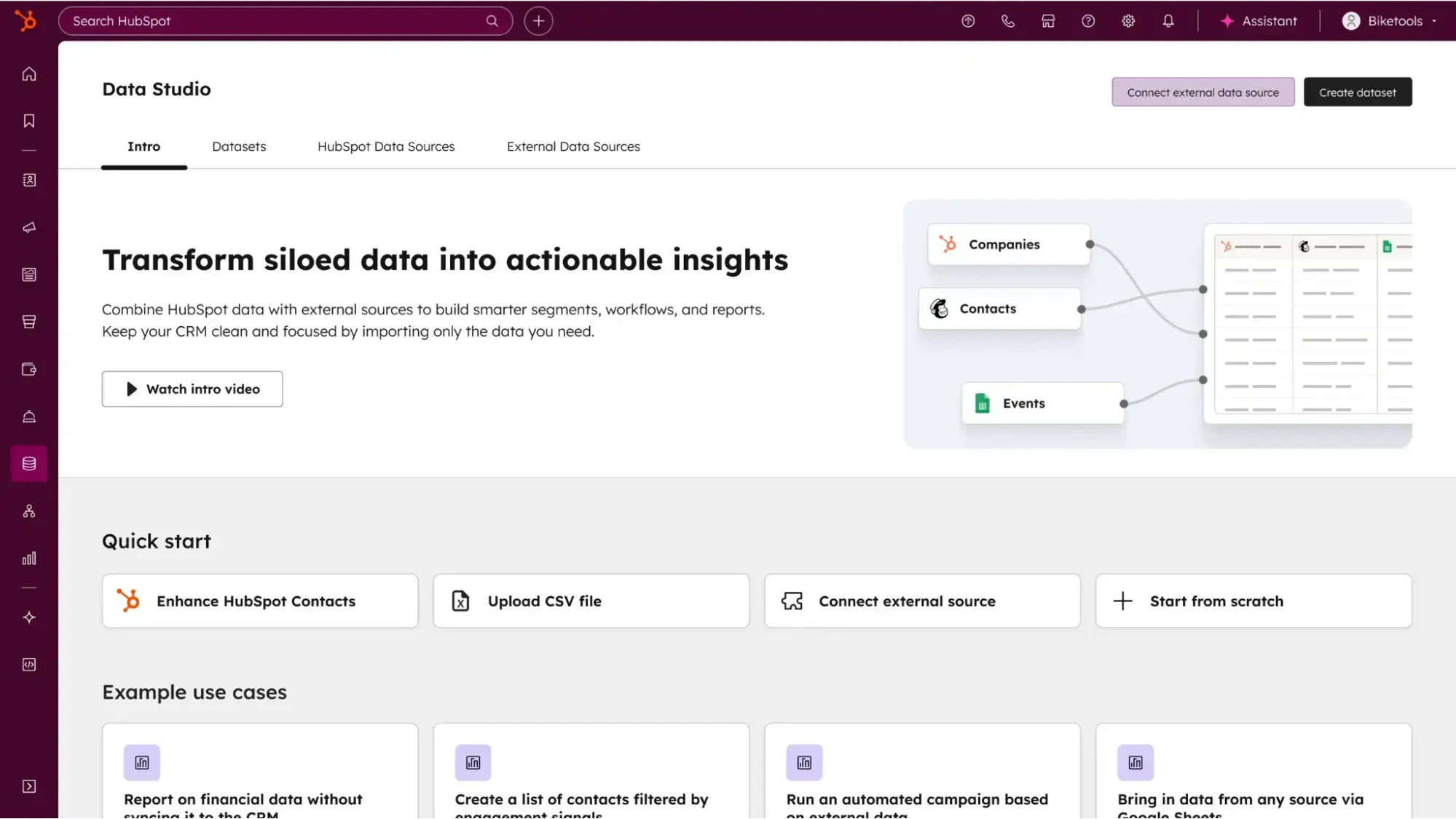
Marketers need to evaluate how campaigns perform. Each team takes a different approach to collecting this data. Some organizations look at reporting dashboards in each tool or channel. Others consolidate data into one platform to see overall performance. Often, teams look at reports in both unified and single-channel tools.
Regardless of the specific approach, tools should collect data that teams need to understand customer needs. Marketing operation tech stack audits note tools that do not gather helpful analytics or fail to store data properly.
Pro tip: Data Hub consolidates data across marketing tech stacks, so teams can unlock insights to run better campaigns.
Content and Asset Management

Content marketing requires a comprehensive tech stack of its own. Teams need a content management system to host blog posts and landing pages. Teams also need tools to aid in content creation (yes, even that Adobe Creative Cloud subscription should be part of the audit).
The best content management tools offer a one-stop shop for hosting, creation, and optimization. Teams seeking a unified approach to content marketing should opt for Content Hub. The tool supports creation, storage, SEO suggestions, and AI-assisted drafting.
Pro tip: Content Hub ties content creation to CRM data and automation activities to support personalization.
Advertising and Paid Media
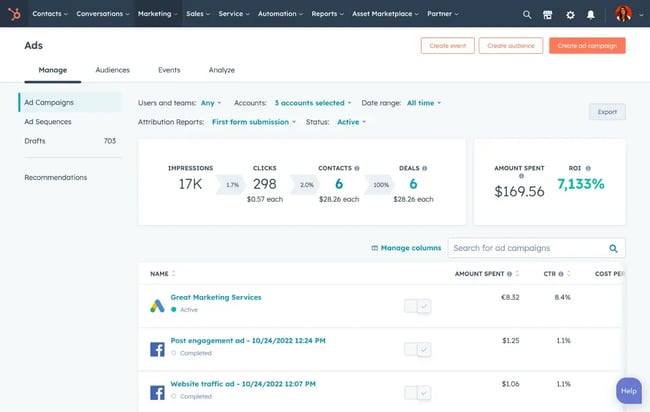
Paid media systems manage campaigns across search, social, and display. Performance improves when these systems connect to the CRM for consistent conversion tracking. Marketing Hub’s Ads tools sync audiences and attach campaign results to lifecycle progression.
Social Media Management

While each social media channel offers some native management capabilities, most brand teams need a comprehensive solution. Social media marketers often look for tools that help with scheduling and creation, as well as social listening. Marketing Hub’s Social Inbox connects this work to CRM records.
SEO and Web Optimization
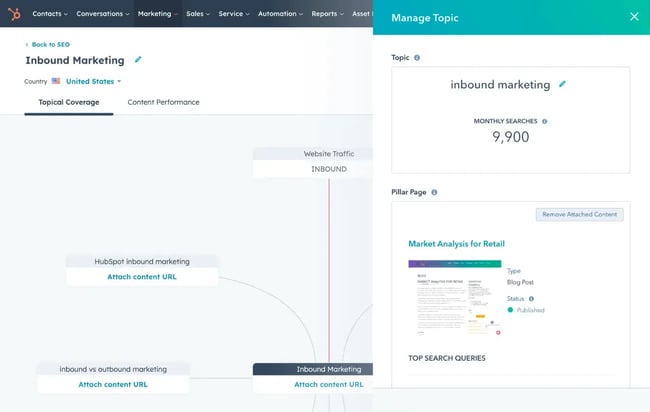
SEO systems support visibility across search. Marketing Hub’s SEO tools offer recommendations, topic clusters, and performance tracking. Teams exploring channel orchestration often extend this work using our guidance on creating an omnichannel experience or building a complete marketing stack.
Pro tip: Marketing Hub’s integrated SEO tools make it easier to know what keywords to target and how to improve page performance.
How to Run a Marketing Operations Tech Stack Audit
A complete audit includes running an inventory of current tools and mapping what data is stored where. Then, marketers score tool performance, note key integrations, and decide if the tool is worth the cost.
The steps below outline a repeatable approach for organizations of any size.
1. Build a complete inventory of every tool
Document each system, outline its purpose, and capture how teams use it. This baseline highlights overlaps and friction points in the workflow. Audit inventory includes the tool name, owner, users, cost, data collected, integrations, and contract details.
Focus on:
- Apps connected to your CRM
- Point solutions used for one-off tasks
- Shadow IT tools adopted without governance
- Renewal dates and contract terms
- Active workflows and automations tied to each tool
2. Map data flows and identify the single system of record
Data mapping shows how contact, event, asset, and revenue information flows across the stack. Smart CRM remains the unified system of record, and the map anchors on that foundation. This map becomes the foundation for future data governance and lifecycle work.
Focus on:
- Where data enters the system
- How it moves between tools
- What transformations happen along the way
- Which tools overwrite or enrich fields
- Where data leaves the ecosystem
3. Evaluate contracts, costs, and usage levels
Contract and usage reviews clarify whether spend matches value. Many teams find overlapping tools, unused seats, or features with limited impact. Renewal timing also shapes consolidation plans.
Focus on:
- Active seats compared to usage logs
- Duplicate categories where multiple tools perform the same task
- Contract terms that affect transition timing
- Coverage fees or volume-based pricing
- Feature gaps that affect key workflows
Understanding usage helps teams make budget recommendations with clear data to support them.
4. Score each tool for impact vs. effort
Once teams know what tools are being used, each needs to be evaluated for its impact. Scoring helps teams understand where each platform contributes. A matrix that assesses the impact on goals and the effort required to maintain the tool provides clarity for planning.
Focus on:
- Workflow impact
- Integration quality
- Automation reliability
- Reporting importance
- Maintenance workload
5. Assess integrations and data sync reliability
At this point in the audit, marketers know which tools are absolutely essential to how the team operates. Any auxiliary technology should integrate with the most important software teams already use. Data gathered from these tools should accurately sync into the CRM and other essential software tools.
Pro tip: Data Hub automates data quality and syncs collected data with HubSpot’s CRM.
Focus on:
- Sync frequency and error logs
- Field mapping and naming conventions
- Data volume limits
- API usage patterns
- Reliability across peak periods
6. Identify redundancies and consolidation opportunities
Redundancies occur when several tools handle similar work or when functions are fragmented across point solutions. Redundant tools should be consolidated or removed.
Focus on:
- Tools with overlapping features
- Single-use platforms with low adoption
- Teams using different systems for similar tasks
- Workflows that require multiple logins
- Legacy tools no longer tied to core processes
Pro tip: HubSpot’s connected ecosystem reduces fragmentation across CRM, automation, content, and data systems.
7. Align lifecycle stages and reporting across platforms
Unified lifecycle data gives teams a stable view of volume, conversion, and funnel velocity. Lifecycle alignment supports consistent reporting and predictable handoffs. Lifecycle stages must be aligned across all platforms.
Focus on:
- Unified lifecycle definitions
- Required fields at each stage
- Lead status and handoff rules
- Reporting filters and naming conventions
- Dashboards used by marketing, sales, and service
8. Build your 30-60-90 day roadmap
A roadmap converts audit findings into a structured plan. Strong roadmaps assign owners, sequence work, and spotlight immediate opportunities for consolidation.
How do we prioritize fixes after the audit?
Start with data stabilization and updates that unlock high-volume workflows. Then move into consolidation, lifecycle cleanup, and reporting changes. Larger platform transitions fit naturally into later phases once stakeholders review the plan.
Where AI Fits in Your Marketing Operations Tech Stack Audit
With a flurry of AI tools, marketers struggle when choosing tools that provide real value. According to Hightouch, only 10% of marketers are using AI effectively today, but 75% want to use AI for more use cases. Luckily, AI can improve the audit process. AI allows for faster discovery and data cleanup. See how below.
Inventory parsing and classification
AI helps categorize tools and highlight overlaps. Once an inventory list is created, AI can group tools by function and flag software with overlapping capabilities. Teams can also import usage data into AI tools like HubSpot’s Breeze AI Suite to see which tools have low usage. This step removes hours of manual review and gives teams a clean starting point.
Duplicate detection and data cleanup
AI surfaces duplicate contacts, conflicting field values, and incomplete lifecycle data. Data Hub is one AI tool that teams can use to improve the quality of data collected across the martech stack. Data can then be stored in HubSpot’s AI CRM for a unified view.
Clean data allows for better visibility and strengthens segmentation, routing, reporting, and automation.
Workflow and integration mapping
AI-powered tools like Data Hub show how information moves across the stack. Teams can then map workflow dependencies and surface workflows that conflict with each other. With AI-powered insights, teams can safely sunset software they no longer need.
Frequently Asked Questions About Marketing Operations Tech Stack Audits
How often should we run a marketing operations tech stack audit?
Most teams run a full audit twice a year and add a lighter quarterly review in fast-changing environments. This cadence maintains data quality and catches issues before they spread.
Should we consolidate to a single platform?
Consolidation works when reducing tools simplifies work, strengthens data quality, or saves budget. HubSpot offers a unified solution for marketers, with SEO, social, and automation tools all under one umbrella.
Who should own the audit and ongoing governance?
Marketing operations or RevOps typically lead this work. Governance then moves to a small cross-functional group that manages lifecycle definitions, field standards, reporting rules, and change processes.
When should we re-platform our CRM or automation?
Re-platforming becomes necessary when data inconsistencies, integration failures, or workflow limitations block progress. HubSpot tools natively integrate with each other, offering a unified approach to data. Teams already using Marketing Hub may benefit from re-platforming to HubSpot’s CRM.
How do we show the audit’s impact to executives?
Executives respond well to improvements in data health, speed to touch, tool cost, and reporting accuracy. Present before-and-after metrics that show duplicate reduction, stronger lifecycle data, and time saved across teams.
Getting Started
A marketing operations tech stack audit helps teams reduce tool redundancy, correct data issues, and strengthen ROI. After an audit, clearer view of how their systems work together and a stronger foundation for ongoing growth. HubSpot Data Hub makes sure that the information collected by a comprehensive marketing operation tech stack is high-quality and centralized in one location.
I’ve seen audits change how teams operate. Clean data supports faster campaigns. Lifecycle alignment brings clarity to reporting. A stable system frees operations teams to focus on strategy rather than troubleshooting.
With a steady audit rhythm, organizations pay only for the tools they actually use and unlock insights that lead to better strategy.

from Marketing https://blog.hubspot.com/marketing/marketing-operations-tech-stack-audit-a-proven-checklist-for-operations-teams
Marketing tech stacks often expand fast, leading to sprawl. The result is low tool usage. Gartner estimates that only 49% of marketing technology tools are actively used by teams. A marketing operations tech stack audit brings structure back to teams with bloated software.
During the audit, teams identify opportunities to cut redundant software, resolve data issues, and improve ROI. Ironically, teams may also surface the need for new tech to manage large volumes of data. HubSpot’s Data Hub is designed to help, combining data across each company’s tech stacks.
This post explores when marketing operations tech stack audits are necessary. Marketers will also learn how to run tech stack audits and where AI fits into the process.
Table of Contents
- What is a marketing operations tech stack audit?
- What You Should Audit in Your Marketing Operations Technology Stack
- How to Run a Marketing Operations Tech Stack Audit
- Where AI Fits in Your Marketing Operations Tech Stack Audit
- Frequently Asked Questions About Marketing Operations Tech Stack Audits
What is a marketing operations tech stack audit?
A marketing operations tech stack audit is a structured review of all marketing, sales, and service tools. The audit identifies tools that do the same job. During the tech stack audit, teams also map what data is collected by each tool and if data is accurate.
At the end of the audit, the team should have a list of every tool that the marketing team uses. Marketers can then see how data moves between systems, what metrics are captured by each tool, and opportunities for consolidation. HubSpot Data Hub stores data from each tool in the tech stack in a central location, breaking down silos.
Tech stack audits allow teams to see what duplicate solutions should be cut. Marketers will also notice which tools create barriers in their workflow and offer little valuable data. Thorough evaluation leads to data consistency and a tech stack that reflects current business priorities.
Benefits of a Marketing Operations Tech Stack Audit
Audits lead to better quality data
According to a report from Hightouch, 75% of pain points related to marketing technology trace back to data issues. Furthermore, a staggering 95% of respondents reported difficulty in targeting and reaching their intended audience. Marketing audits help solve that challenge.
Tool reviews help teams see what data is being collected, whether the data is useful, and if it’s being stored in a way that benefits marketing campaigns. HubSpot Data Hub can help teams looking to unify data and unlock insight into what potential customers are looking for.
With martech audits, teams spend only on the tools they use
According to Hightouch, marketers have access to an average of 90 tools and don’t use 70% of them. A Gartner report found that low usage costs businesses real dollars. In fact, the advisory firm found that billion-dollar companies with average tool utilization can waste up to $8.5 million. Marketing operation tech stack audits help teams identify and eliminate underused tools.
Smaller tech stacks mean less time spent on training
According to Gartner, companies that use four or more enablement methods show stronger marketing technology performance. Teams must invest in training and development to unlock technological capabilities and perform well. Fewer tools mean less time needs to be spent on training. Marketers only learn how to use the tools they actually need.
What You Should Audit in Your Marketing Operations Technology Stack
A comprehensive marketing operations technology stack includes a CRM to manage customer interactions, automation for key campaigns, and analytics to improve performance. Most teams also benefit from content marketing tools that improve SEO systems and social media management tools. Each category warrants a review of ownership and usage.
The sections below outline the core areas to review and the HubSpot products that support a more connected stack.
CRM and Contact Management
The CRM shapes how customer data moves across the lifecycle. HubSpot’s Smart CRM centralizes records across marketing, sales, and service. With a unified source of data, marketing teams can more easily segment customers and personalize campaigns. Teams often review CRM activity alongside inside sales technologies to understand how engagement moves through the funnel.
Pro tip: HubSpot CRM brings every interaction into a unified record for simpler workflows and more reliable reporting.
Marketing Automation
Marketing automation platforms streamline repetitive marketing tasks using pre-built workflows. Tools like HubSpot Marketing Hub also use customer data stored in CRMs to power personalized marketing campaigns. Marketing automation often focuses on creating email workflows, qualifying leads, and routine posting.
Pro tip: Marketing Hub centralizes email, automation, forms, and journeys in a single environment.
Data and Analytics
Marketers need to evaluate how campaigns perform. Each team takes a different approach to collecting this data. Some organizations look at reporting dashboards in each tool or channel. Others consolidate data into one platform to see overall performance. Often, teams look at reports in both unified and single-channel tools.
Regardless of the specific approach, tools should collect data that teams need to understand customer needs. Marketing operation tech stack audits note tools that do not gather helpful analytics or fail to store data properly.
Pro tip: Data Hub consolidates data across marketing tech stacks, so teams can unlock insights to run better campaigns.
Content and Asset Management
Content marketing requires a comprehensive tech stack of its own. Teams need a content management system to host blog posts and landing pages. Teams also need tools to aid in content creation (yes, even that Adobe Creative Cloud subscription should be part of the audit).
The best content management tools offer a one-stop shop for hosting, creation, and optimization. Teams seeking a unified approach to content marketing should opt for Content Hub. The tool supports creation, storage, SEO suggestions, and AI-assisted drafting.
Pro tip: Content Hub ties content creation to CRM data and automation activities to support personalization.
Advertising and Paid Media
Paid media systems manage campaigns across search, social, and display. Performance improves when these systems connect to the CRM for consistent conversion tracking. Marketing Hub’s Ads tools sync audiences and attach campaign results to lifecycle progression.
Social Media Management
While each social media channel offers some native management capabilities, most brand teams need a comprehensive solution. Social media marketers often look for tools that help with scheduling and creation, as well as social listening. Marketing Hub’s Social Inbox connects this work to CRM records.
SEO and Web Optimization
SEO systems support visibility across search. Marketing Hub’s SEO tools offer recommendations, topic clusters, and performance tracking. Teams exploring channel orchestration often extend this work using our guidance on creating an omnichannel experience or building a complete marketing stack.
Pro tip: Marketing Hub’s integrated SEO tools make it easier to know what keywords to target and how to improve page performance.
How to Run a Marketing Operations Tech Stack Audit
A complete audit includes running an inventory of current tools and mapping what data is stored where. Then, marketers score tool performance, note key integrations, and decide if the tool is worth the cost.
The steps below outline a repeatable approach for organizations of any size.
1. Build a complete inventory of every tool
Document each system, outline its purpose, and capture how teams use it. This baseline highlights overlaps and friction points in the workflow. Audit inventory includes the tool name, owner, users, cost, data collected, integrations, and contract details.
Focus on:
- Apps connected to your CRM
- Point solutions used for one-off tasks
- Shadow IT tools adopted without governance
- Renewal dates and contract terms
- Active workflows and automations tied to each tool
2. Map data flows and identify the single system of record
Data mapping shows how contact, event, asset, and revenue information flows across the stack. Smart CRM remains the unified system of record, and the map anchors on that foundation. This map becomes the foundation for future data governance and lifecycle work.
Focus on:
- Where data enters the system
- How it moves between tools
- What transformations happen along the way
- Which tools overwrite or enrich fields
- Where data leaves the ecosystem
3. Evaluate contracts, costs, and usage levels
Contract and usage reviews clarify whether spend matches value. Many teams find overlapping tools, unused seats, or features with limited impact. Renewal timing also shapes consolidation plans.
Focus on:
- Active seats compared to usage logs
- Duplicate categories where multiple tools perform the same task
- Contract terms that affect transition timing
- Coverage fees or volume-based pricing
- Feature gaps that affect key workflows
Understanding usage helps teams make budget recommendations with clear data to support them.
4. Score each tool for impact vs. effort
Once teams know what tools are being used, each needs to be evaluated for its impact. Scoring helps teams understand where each platform contributes. A matrix that assesses the impact on goals and the effort required to maintain the tool provides clarity for planning.
Focus on:
- Workflow impact
- Integration quality
- Automation reliability
- Reporting importance
- Maintenance workload
5. Assess integrations and data sync reliability
At this point in the audit, marketers know which tools are absolutely essential to how the team operates. Any auxiliary technology should integrate with the most important software teams already use. Data gathered from these tools should accurately sync into the CRM and other essential software tools.
Pro tip: Data Hub automates data quality and syncs collected data with HubSpot’s CRM.
Focus on:
- Sync frequency and error logs
- Field mapping and naming conventions
- Data volume limits
- API usage patterns
- Reliability across peak periods
6. Identify redundancies and consolidation opportunities
Redundancies occur when several tools handle similar work or when functions are fragmented across point solutions. Redundant tools should be consolidated or removed.
Focus on:
- Tools with overlapping features
- Single-use platforms with low adoption
- Teams using different systems for similar tasks
- Workflows that require multiple logins
- Legacy tools no longer tied to core processes
Pro tip: HubSpot’s connected ecosystem reduces fragmentation across CRM, automation, content, and data systems.
7. Align lifecycle stages and reporting across platforms
Unified lifecycle data gives teams a stable view of volume, conversion, and funnel velocity. Lifecycle alignment supports consistent reporting and predictable handoffs. Lifecycle stages must be aligned across all platforms.
Focus on:
- Unified lifecycle definitions
- Required fields at each stage
- Lead status and handoff rules
- Reporting filters and naming conventions
- Dashboards used by marketing, sales, and service
8. Build your 30-60-90 day roadmap
A roadmap converts audit findings into a structured plan. Strong roadmaps assign owners, sequence work, and spotlight immediate opportunities for consolidation.
How do we prioritize fixes after the audit?
Start with data stabilization and updates that unlock high-volume workflows. Then move into consolidation, lifecycle cleanup, and reporting changes. Larger platform transitions fit naturally into later phases once stakeholders review the plan.
Where AI Fits in Your Marketing Operations Tech Stack Audit
With a flurry of AI tools, marketers struggle when choosing tools that provide real value. According to Hightouch, only 10% of marketers are using AI effectively today, but 75% want to use AI for more use cases. Luckily, AI can improve the audit process. AI allows for faster discovery and data cleanup. See how below.
Inventory parsing and classification
AI helps categorize tools and highlight overlaps. Once an inventory list is created, AI can group tools by function and flag software with overlapping capabilities. Teams can also import usage data into AI tools like HubSpot’s Breeze AI Suite to see which tools have low usage. This step removes hours of manual review and gives teams a clean starting point.
Duplicate detection and data cleanup
AI surfaces duplicate contacts, conflicting field values, and incomplete lifecycle data. Data Hub is one AI tool that teams can use to improve the quality of data collected across the martech stack. Data can then be stored in HubSpot’s AI CRM for a unified view.
Clean data allows for better visibility and strengthens segmentation, routing, reporting, and automation.
Workflow and integration mapping
AI-powered tools like Data Hub show how information moves across the stack. Teams can then map workflow dependencies and surface workflows that conflict with each other. With AI-powered insights, teams can safely sunset software they no longer need.
Frequently Asked Questions About Marketing Operations Tech Stack Audits
How often should we run a marketing operations tech stack audit?
Most teams run a full audit twice a year and add a lighter quarterly review in fast-changing environments. This cadence maintains data quality and catches issues before they spread.
Should we consolidate to a single platform?
Consolidation works when reducing tools simplifies work, strengthens data quality, or saves budget. HubSpot offers a unified solution for marketers, with SEO, social, and automation tools all under one umbrella.
Who should own the audit and ongoing governance?
Marketing operations or RevOps typically lead this work. Governance then moves to a small cross-functional group that manages lifecycle definitions, field standards, reporting rules, and change processes.
When should we re-platform our CRM or automation?
Re-platforming becomes necessary when data inconsistencies, integration failures, or workflow limitations block progress. HubSpot tools natively integrate with each other, offering a unified approach to data. Teams already using Marketing Hub may benefit from re-platforming to HubSpot’s CRM.
How do we show the audit’s impact to executives?
Executives respond well to improvements in data health, speed to touch, tool cost, and reporting accuracy. Present before-and-after metrics that show duplicate reduction, stronger lifecycle data, and time saved across teams.
Getting Started
A marketing operations tech stack audit helps teams reduce tool redundancy, correct data issues, and strengthen ROI. After an audit, clearer view of how their systems work together and a stronger foundation for ongoing growth. HubSpot Data Hub makes sure that the information collected by a comprehensive marketing operation tech stack is high-quality and centralized in one location.
I’ve seen audits change how teams operate. Clean data supports faster campaigns. Lifecycle alignment brings clarity to reporting. A stable system frees operations teams to focus on strategy rather than troubleshooting.
With a steady audit rhythm, organizations pay only for the tools they actually use and unlock insights that lead to better strategy.
via Perfecte news Non connection

No hay comentarios:
Publicar un comentario